

This article is part of a series we produced to honor the 25th anniversary of September 11th, 2001. In memoriam of the victims, their stories, and their legacy, we focus primarily on the attacks themselves and their immediate aftermath.
It contains a curated selection of stories about the untold number of hero’s, victims, and survivors. The perpetrators are mentioned only in passing, by design.
There is a brief detour inspired by former FBI agent John O’Neil and retired Army Colonel Cyril Richard Rescorla, who perished evacuating others from the Towers. Had they been listened to, the attack may have never happened in the first place..
Special thanks to all the members of the World Trade Center Memories Facebook group, many of whom are themselves survivors, and without whom this would not be what it is.
We would also like to thank the many journalists who worked tirelessly and at great personal risk to document these events, without whom this wouldn’t have been possible at all.


The terror attacks on September 11th were the deadliest in history, and resulted in the single deadliest day for first responders in the history of the United States.
At first, it was unknown how many Americans had been killed. The final count turned out to be much lower than many had initially feared.
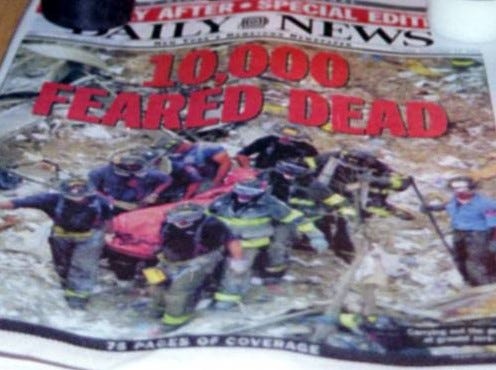
Even so, thousands of American civilians were killed, a death toll that has continued to rise from the health impact of toxic chemicals and particulate matter that blanketed the City, marking the beginning of what would become known as the global war on terror.


The September 11 attacks, commonly known simply as September 11th or just 9/11, were coordinated terrorist hijackings carried out against the United States.
The attacks were perpetrated by militant Islamist fundamentalists associated with the group al-Qaeda. The group weaponized commuter airplanes to target buildings across the East Coast of the United States.
al-Qaeda was one of many pan-Islamist militant organizations mostly based in the Middle East, a constellation of fundamentalist groups led by Salafi jihadists intent on creating a new global Islamic Caliphate. It still exists today, along with a number of offshoot groups like the Islamic State.
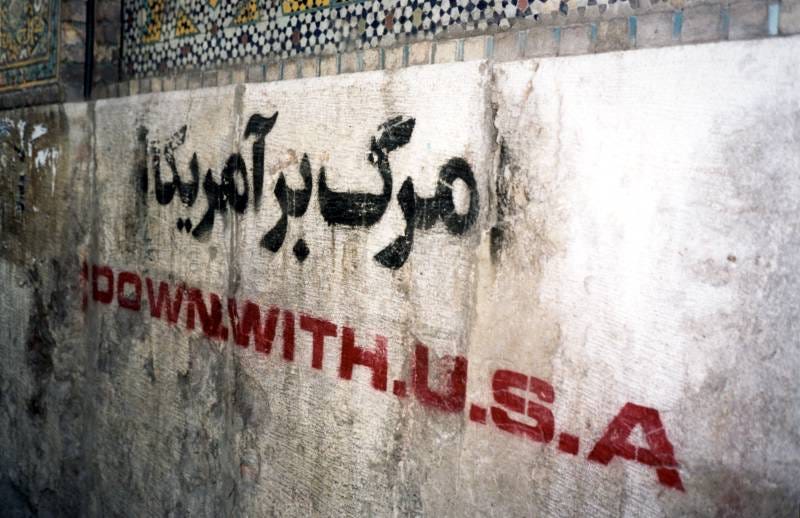
As a result of the attacks, spontaneous celebrations emerged across the Middle East and beyond as radical Muslims openly celebrated the murder of thousands of Americans following the attacks on September, 11, 2001.
These Islamist celebrations, reported by multiple news sources, included thousands of people who poured into the streets of Gaza, chanting “God is Great,” honking horns, flashing the victory sign, carrying Palestinian flags, and shooting into the air.
Other known and documented celebrations took place in Egypt, Lebanon, and Jordan. Outside of the middle east, celebrations were reported within Muslim communities in Indonesia, Bangladesh, India and, while subject to some debate, even in the United States and London.
It started on the morning of September 11th, when 19 jihadi terrorists hijacked four commercial airliners after take off from New England, New Jersey, and Washington D.C.:
American Airlines Flight 11 and United Airlines Flight 175 both departed from Logan International Airport in Boston, at 7:59 A.M. and 8:14 A.M. respectively.
American Airlines Flight 77 departed from Dulles International Airport in Washington D.C. at 8:20 A.M.
United Airlines Flight 93 departed from Newark International Airport in New Jersey at 8:42 A.M.
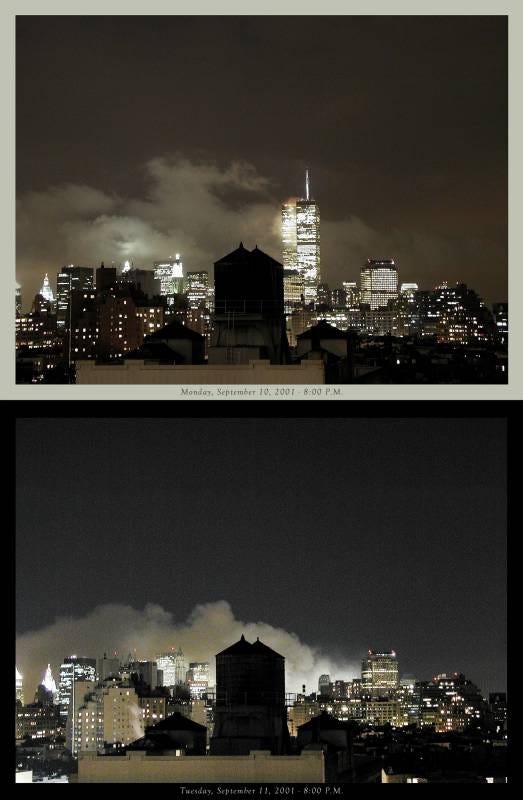
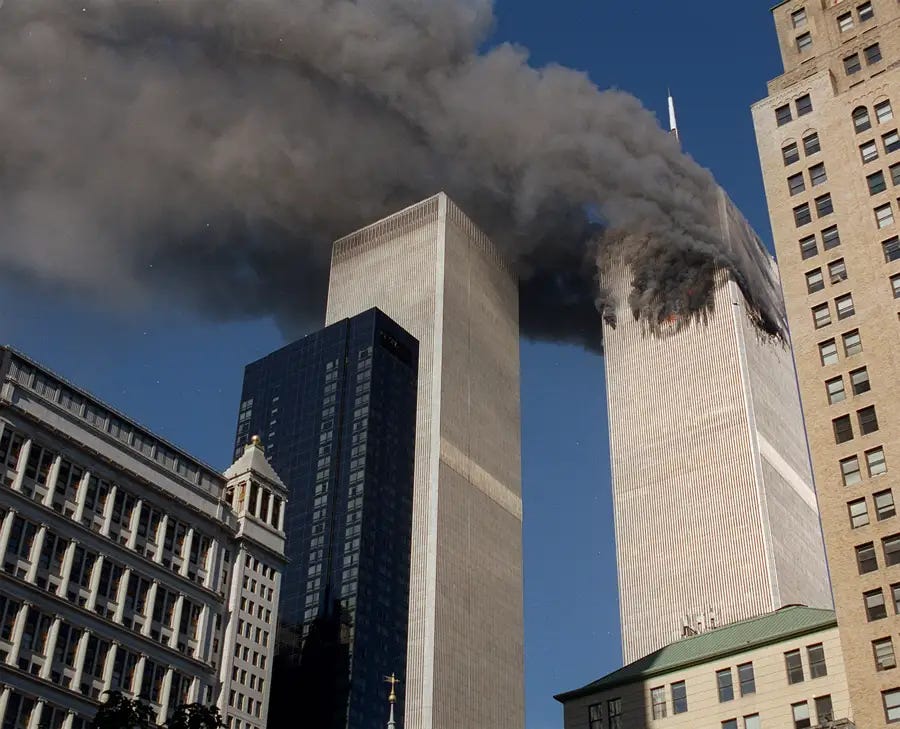
The first plane destroyed in the attacks was American Airlines Flight 11, which was also the first plane to be hijacked. It was intentionally crashed directly into the North Tower of the World Trade Center complex in Lower Manhattan at 08:46 A.M.


Daniel Lewin, a passenger on board American Airlines Flight 11, is believed to be the first victim of the September 11 attacks. Lewin, who had dual American-Israeli citizenship, was known as a brilliant computer scientist who helped invent an algorithm for optimizing Internet traffic.
He had also served for four years in the Israel Defense Forces as an officer in Sayeret Matkal, the IDF's premier special forces unit, earning the rank of captain.
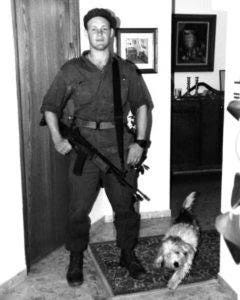
The 9/11 Commission report speculated that Daniel Lewin may have attempted to confront the hijackers. Two had been seated directly in front of him; he was stabbed from behind.
Reports suggest he may have had his throat slit not realizing that a third terrorist was sitting just behind him. He was survived by his wife, Anne, and two young sons, Eitan and Itamar.
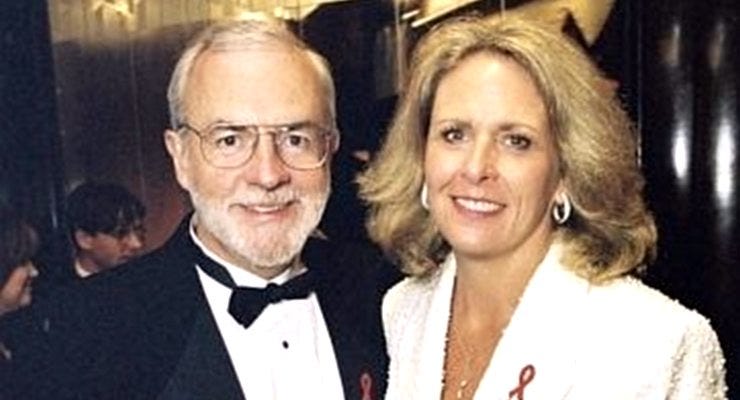
David Angell, creator of Frasier and Wings, and a former writer for Cheers, died on American Airlines Flight 11 with his wife Lynn.
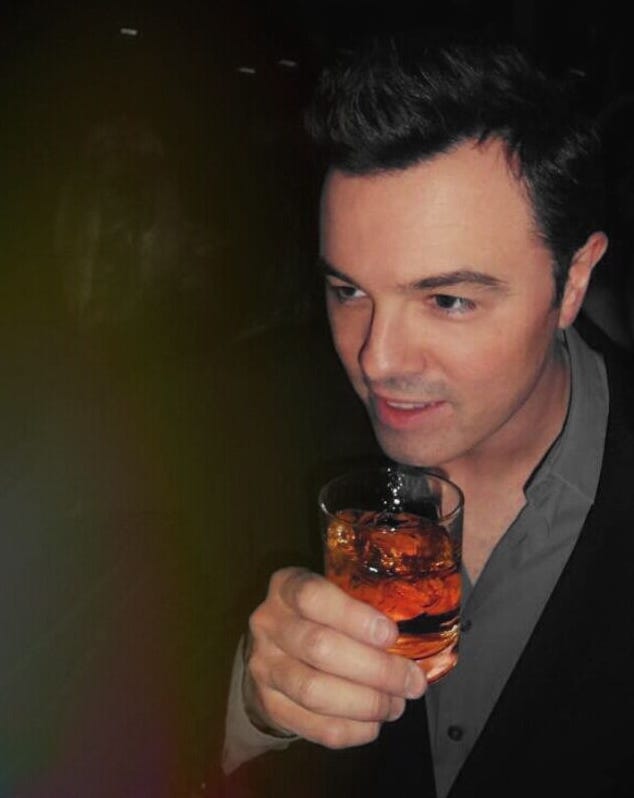
Seth MacFarlane (of Family Guy, American Dad, and Ted) would have died on American Airlines Flight 11 to Los Angeles, but he told Larry King that his life was saved by a hangover, as he had been drinking heavily the night before, and missed his alarm. He woke up to voice mail messages from friends and family who believed he was dead.
Flight attendant Madeline Sweeney did not miss her flight. She missed seeing her daughter off to kindergarten to work her shift on Flight 11; she was covering for another employee who had taken a sick day.
She called American Airlines manager Michael Woodward from the plane to report the hijacking, and told Woodward that one of the hijackers had shown her a device with red and yellow wires that appeared to be a bomb.
She was still on the phone with Woodward when the plane crashed into the North Tower.
"I see water. I see buildings. I see buildings! We are flying low. We are flying very, very low. We are flying way too low. Oh my God we are flying way too low. Oh my God!"
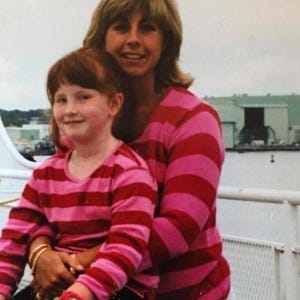
Her daughter, Anna Sweeney, told WCVB Boston in 2021, “I've lived most of my life without my mom, but I don't forget her. I don't forget her, I think about her every single day. I don't forget her being a hero.”
She added, “Not just for me or my family, but clearly for other people as well, and that's something that I'm very proud of and that I look up to a lot.”
Betty Ong, 45, another flight attendant on American Airlines Flight 11, volunteered to work Flight 11 so she that she could go on vacation to Hawaii with her sister.
Betty Ong was the first person to report the hijackings; she called American Airlines reservations using a seat back Airfone at the back of the plane.

Along with fellow flight attendant Madeline Amy Sweeney, she relayed the seat numbers of three hijackers, allowing investigators to identify them. As a result, the 9/11 Commission declared Ong and Sweeney national heroes, and so did the state of Massachusetts.
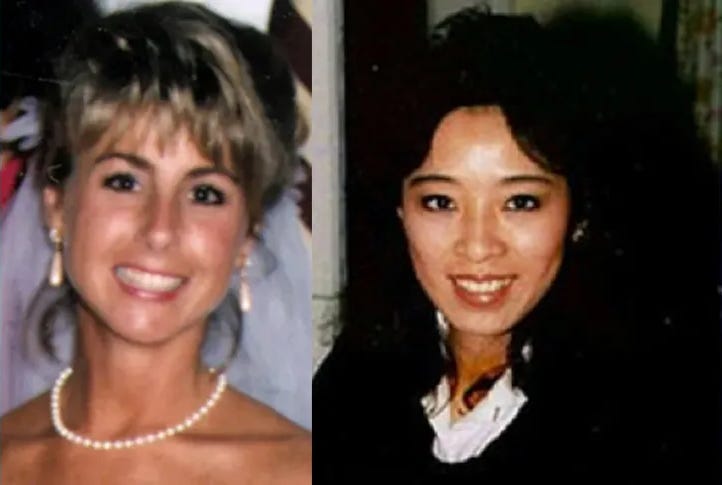
The annual Madeline Amy Sweeney Award for Civilian Bravery is awarded every September 11 to at least one Massachusetts resident who displayed extraordinary courage in defending or saving the lives of others.
The first recipients were Sweeney herself, Betty Ong, and Flight 11 Captain John Ogonowski, a Vietnam veteran who transported equipment and the bodies of fallen Americans for the Air Force before going to work for American Airlines in 1975. All three were residents of Massachusetts.
This is an excerpt from Betty Ong’s conversation with the American Airlines Ground Crew.
Ong: The cockpit's not answering. Somebody's stabbed in business class, and um, I think there is mace that we can't breathe. I don't know, I think we're getting hijacked … my name is Betty Ong. I'm Number 3 on Flight 11.
Ong: Our — our Number 1 got stabbed. Our purser is stabbed. Ah, nobody knows who stabbed who and we can't even get up to business class right now because nobody can breathe. Our Number 1 is — is stabbed right now. And our Number 5. Our first-class passenger that, first class galley flight attendant and our purser has been stabbed and we can't get to the cockpit, the door won't open. Hello? … Can anybody get up to the cockpit? We can't even get into the cockpit. We don't know who's up there.
AAL: Well if they were shrewd, they would keep the door closed, and —
Ong: I'm sorry?
AAL: Would they not maintain a sterile cockpit?
AAL: What's going on, Betty? Betty, talk to me. Betty, are you there? Betty? (Inaudible) Do you think we lost her? OK, so we'll like — we'll stay open. We — I think we might have lost her.
Rahma Salie, 28, from Boston was also onboard American Airlines Flight 11. Rahma, 7 months pregnant, was a technology executive traveling with her husband of 3 years, Michael Theodoridis, 32.
Rahma's mother, Haleema, said, "I would like everyone to know that she was a Muslim, she is a Muslim and we are victims too, of this tragic incident."
This is the only known clear video of the incident; it was captured accidentally by documentary filmmakers Jules Clément Naudet and his brother Thomas Gédéon Naudet.
They were in New York filming a documentary on members of the FDNY Engine 7, Ladder 1 firehouse in Lower Manhattan. The firemen had ventured out to investigate reports of a gas leak from a storm drain. Their footage was used for the 2002 documentary 9/11.
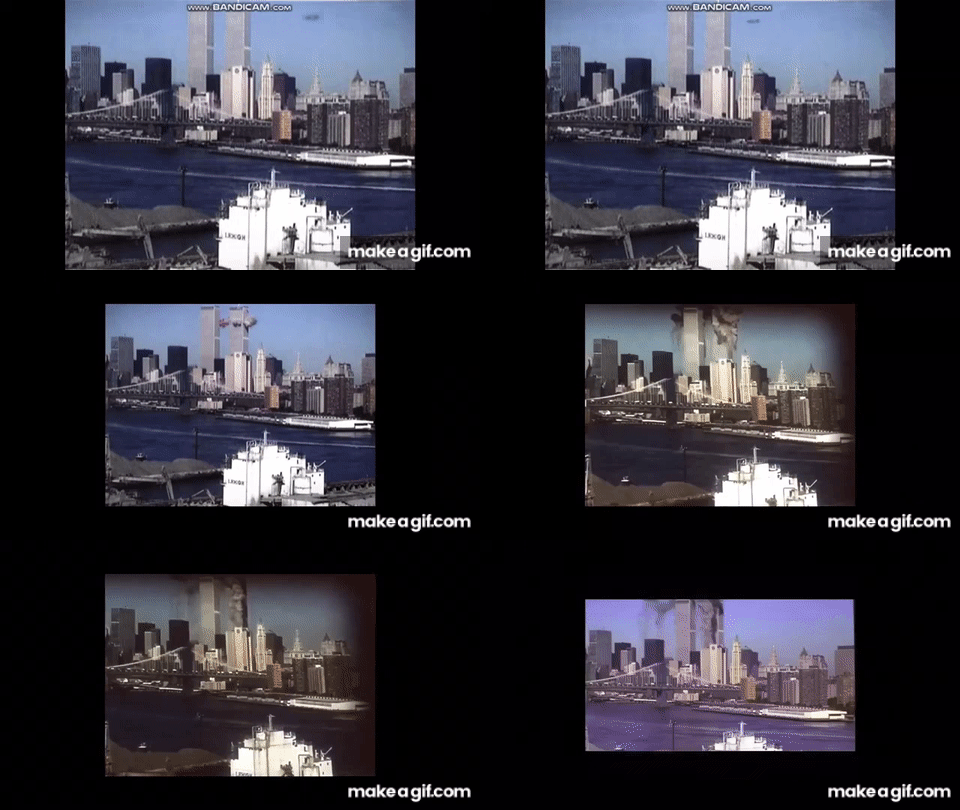
Another video of the incident was taken by Pavel Hlava, an immigrant worker from the Czech Republic who was in traffic when he caught the tragedy on camera. Hlava has the distinction of being the only person to capture both crashes on film, and it was a coincidence of heavy traffic that he did so.
He captured Flight 11 just before entering the Brooklyn–Battery Tunnel and captured United 175 just as he emerged from it. He reportedly didn’t even realize that he had filmed the first impact until he reviewed the footage, and zoom in on what you can see below.
A third person, Wolfgang Staehle, captured images of the impact via webcam. Staehle is a media artist who first began streaming video to the web from NYC in 1996.
Lauren Pritchard Manning was walking through the glass doors of the North Tower's West Street entrance when the plane crashed into the elevator shafts that gave the explosive jet fuel fires a direct pathway down to the first floor lobby.
As she turned towards the elevators that would take her up to her office, fire blasted from the elevator shafts. Manning fought her way out to the sidewalk outside, running away from the building across six lanes of traffic before she stopped and dropped down to roll on some grass.
A good Samaritan helped put out the flames. Despite suffering burns to over 80 percent of her body, Manning remained conscious and watched from below as Flight 175 crashed into the South Tower. Her ambulance didn’t leave the World Trade Center until about ten minutes before the South Tower collapsed.
She was still in critical condition when she was woken up towards the end of October 2001, and was not told that both towers had collapsed and that 658 of her colleagues at Cantor Fitzgerald had been killed until mid-November. Manning wrote a memoir, Unmeasured Strength, that she published in 2011.
A survivor named Ed Kotski managed to take some surreal pictures as he escaped from the North Tower, documenting what it was like for survivors. He also wrote down his experiences from that day, which he published on his website. We have shared it below, edited for length and to comply with fair use.
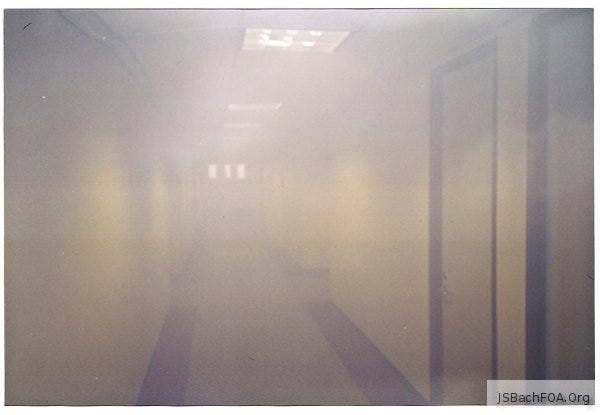
Ed Kotski writes,
…The simple fact is that I was oblivious to what was going on, from beginning to end…
Our office was on the 74th floor of WTC 1, (The North Tower) which was the first to get hit… I was working on the computer when there was a big "boom" and the building shook… Next came a strange sound like hail hitting a window, but with some additional scratchy noises, while a blizzard of papers and sheet metal flew past the window. Some of it was burning, but most was just letter size documents, which you could almost read as they flew past. Up through the window, I could see a huge cloud of black smoke coming from the floors above.
The fire alarms began to sound, but Ed Kotski had no idea what was happening. He wrote that he had previously decided that if the building were to be bombed he would wait to evacuate because he thought if the incident was a terrorist act, they might target survivors evacuating the building.
"We went down 78 flights of stairs and got out of the building… I sat there on the curb and finally looked up to see what was happening and listened to people on the ground saying what happened, because we didn't know…”
—Survivor Kelly Reyher
Instead, he tried to call his wife, but was unable to reach her, and he, “left word that there had been some kind of explosion in the building, but that I was fine, and that I intended to remain in the building to let things settle down.”
He then called his son in law, who told him that a passenger jet had crashed into the North Tower, and begged Ed to evacuate because he thought it looked “like the building was getting ready to come down.”
Ed Kotski took his son in laws words to heart; he was preparing to leave when Flight 175 crashed into the South Tower.
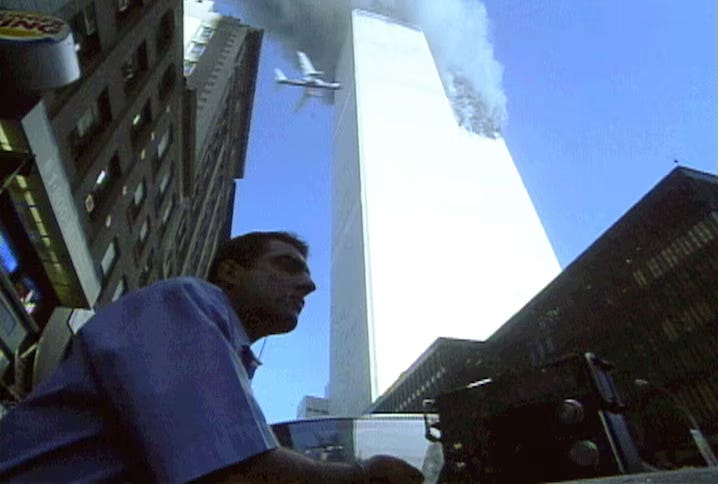
I am pretty sure that I was still at my desk, probably shutting down my computer, and I know I was still in the office, when the second building was hit… There was another "boom", and our building shook again.


When we first started down, the stairway had a little smoke in it, but it wasn't bad. More worrisome was the water running down from the floors above. The soles of my shoes were slippery on the wet floor, and I almost fell once, but was able to grab the railing…
Somewhere around the thirtieth floor, we started catching up to others going down, and we met the first firemen coming up… The air in the stairwell also cleared up somewhere around here, and the stairs were dry, so I was sure that I was home free. The clear air didn't last for long. It turned out to be sitting on top of more smoke, and it soon became difficult to see and to breathe…
We continued down, through increasing smoke, but guided by firemen with bright flashlights. I'm not sure which floor I was on when I almost fell down the stairs again. I couldn't see where the floor ended and the steps began. Maybe I could have caught myself, because I was moving slowly, but I let out a "oops" and two very strong hands grabbed me. I have a pair of bruises, one on each arm, to remind me of two men whom I hope got out in time.
When we reached the sixth floor, there was another big boom, and the building shook again. I head someone say, "it's ok, we're in the strongest part of the building", which I knew was true. What I didn't know was that the boom was the other building collapsing. We stayed put for couple of minutes, and then started down again…
Firemen were directing us to "go straight ahead, don't look to the right"… Later, my colleague told me that he had looked. The firemen hadn't wanted us to see dismembered bodies…
I think that I was in one of the last groups to leave the building. We had to walk single file over rubble, and ahead of us, a couple of workers were pulling a piece of sheet metal out of the way, so that we could stay under the protection of the overhang of an adjacent building…


The North Tower was hit by American Airlines Flight 11 at 08:46. Seventeen minutes later, at 09:03, the World Trade Center's South Tower was hit by United Airlines Flight 175. Just before the impact, Brian Sweeney, a 38-year-old aeronautics consultant and former Navy pilot, left a final voicemail for the wife he'd left behind in Massachusetts.
"Jules, this is Brian. Listen, I'm on an airplane that's been hijacked," he said. "If things don't go well, and it's not looking good, I just want you to know that I absolutely love you. I want you to do good, go have good times — same to my parents and everybody — and I just totally love you … and I'll see you when you get there. Bye babe. I hope I call you."
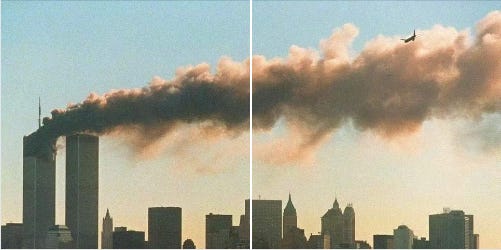
Brian also called his mother to say he loved her, and to tell her the passengers were planning a counter offensive. "I might have to go,” he said. “We are going to try to do something about this."
Sadly, they didn’t have time; the plane crashed into the South Tower just minutes after Brian Sweeney hung up the phone.
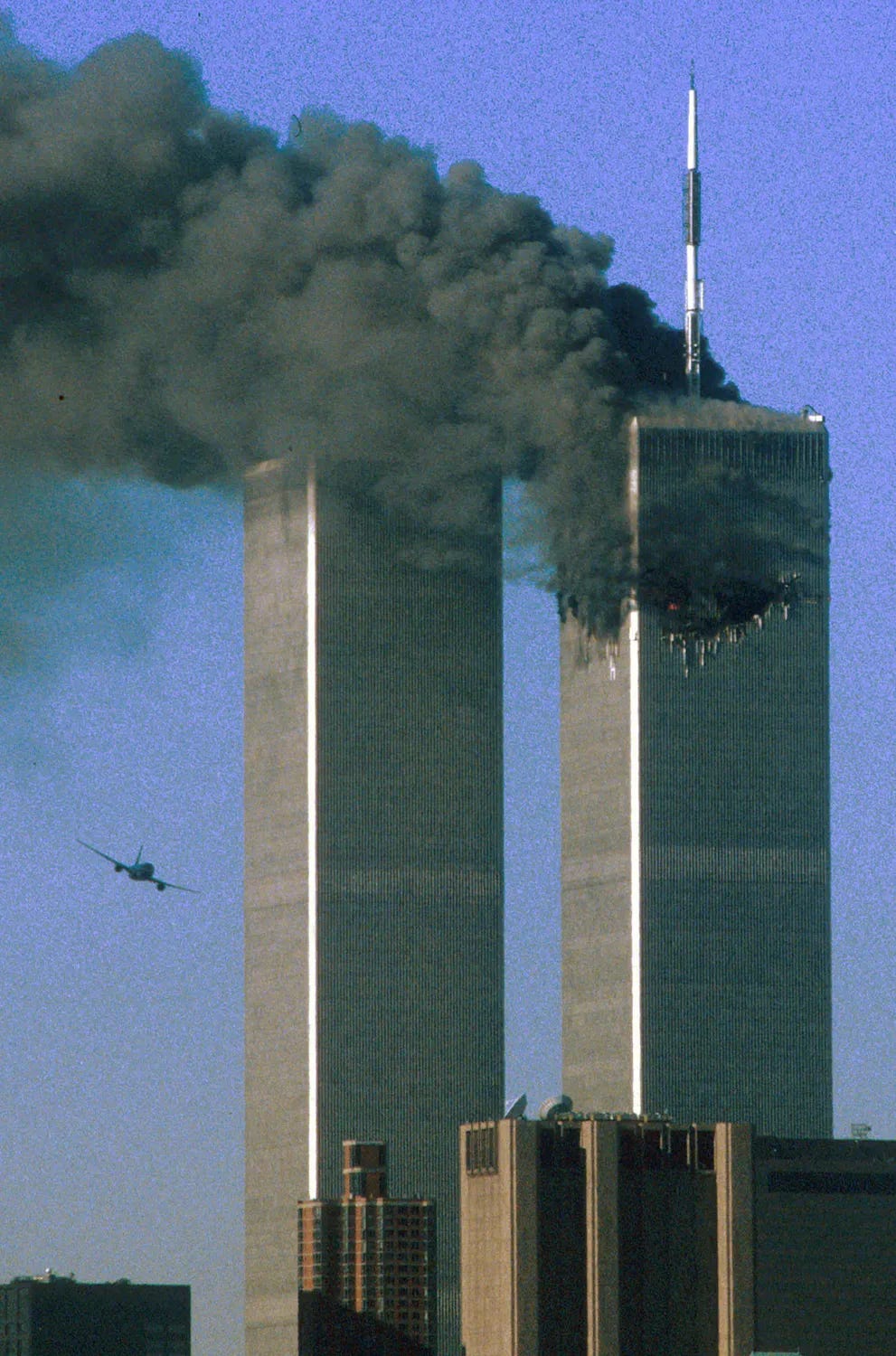
Stanley Praimnath was working on the 81st floor of the South Tower when United Airlines Flight 175 crashed into the side of it. He had evacuated the building after American Airlines Flight 11 hit the North Tower but he went back inside after South Tower security told evacuees that the South Tower was secure and that they should return to their offices.
After he made it back to his office on the 81st floor, Praimnath was on the phone when he looked out of his south facing office windows and froze in panic as he stared out at a Boeing 767 coming right at him at around 587 miles per hour.
Praimnath jumped under his desk for cover as the left wing of United Airlines Flight 175 sliced directly through his office only feet from where he had sheltered beneath his desk, leaving him covered in debris after the crash, stuck and unable to escape on his own. The wing reportedly lodged itself in a wall and through a doorway.
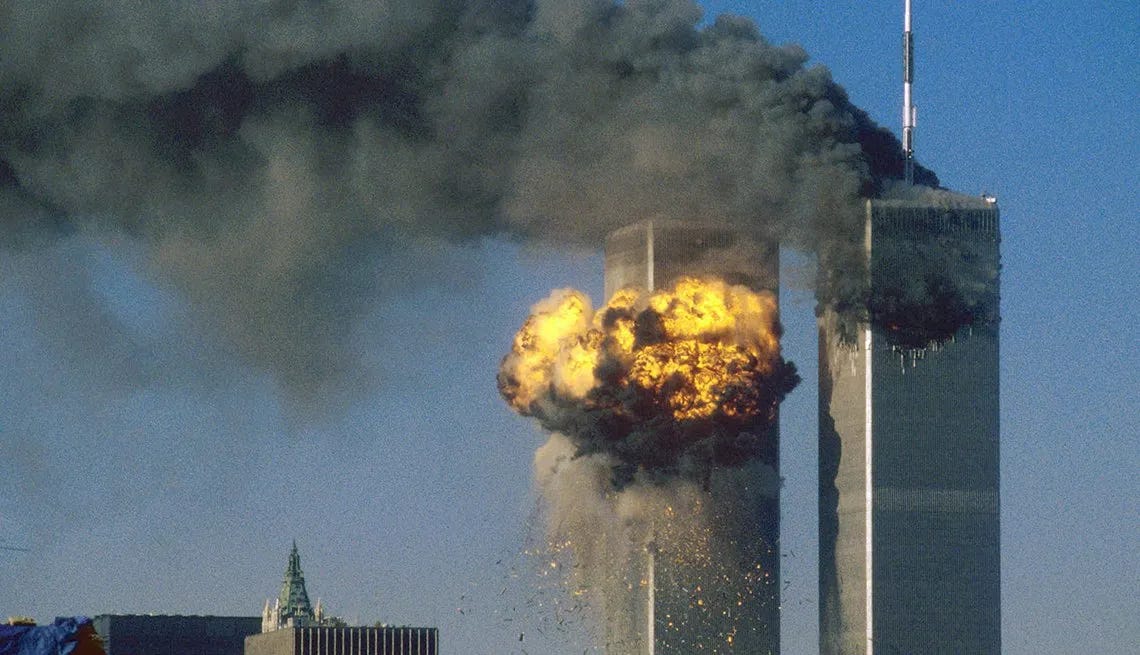
Video of a man with the day off from his job on the 83rd floor of Tower Two watching in disbelief, and freaking out about the fact that he is only alive by chance, was released in the ITV documentary Life Under Attack / 9/11: I Was There in 2021.
Prior to Flight 175 colliding with the South Tower, the media maintained a cautious optimism that Flight 11 may have been some kind of tragic accident.
“Was it a terrorist attack?”
Howard Stern
Immediately following the second collision with South Tower, optimism gave way to despair, as newscasters realized that the United States was under some kind of attack. Many broke down live on the air, unable to maintain their composure watching helplessly as thousands and thousands of American civilians were murdered.
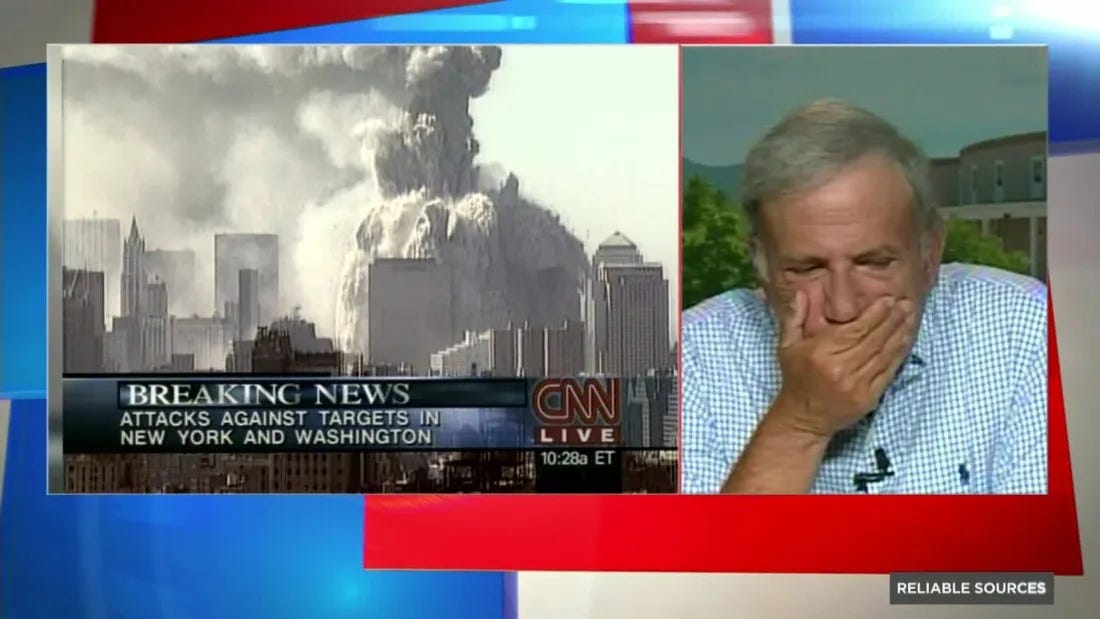
You can see the same stunned horror in video captured by a high school student in Virginia who was filming a class project that morning just before the class learned what was unfolding.
Comparisons to Pearl Harbor began almost immediately. Just after 9:05 A.M., while watching Flight 175 explode as it crashed into the South Tower, Howard Stern exclaimed, “We’re under attack. We’re under attack, it’s war, this is Pearl Harbor. We gotta bomb the hell out of them, you know who it is, I can’t say but we know who it is.”
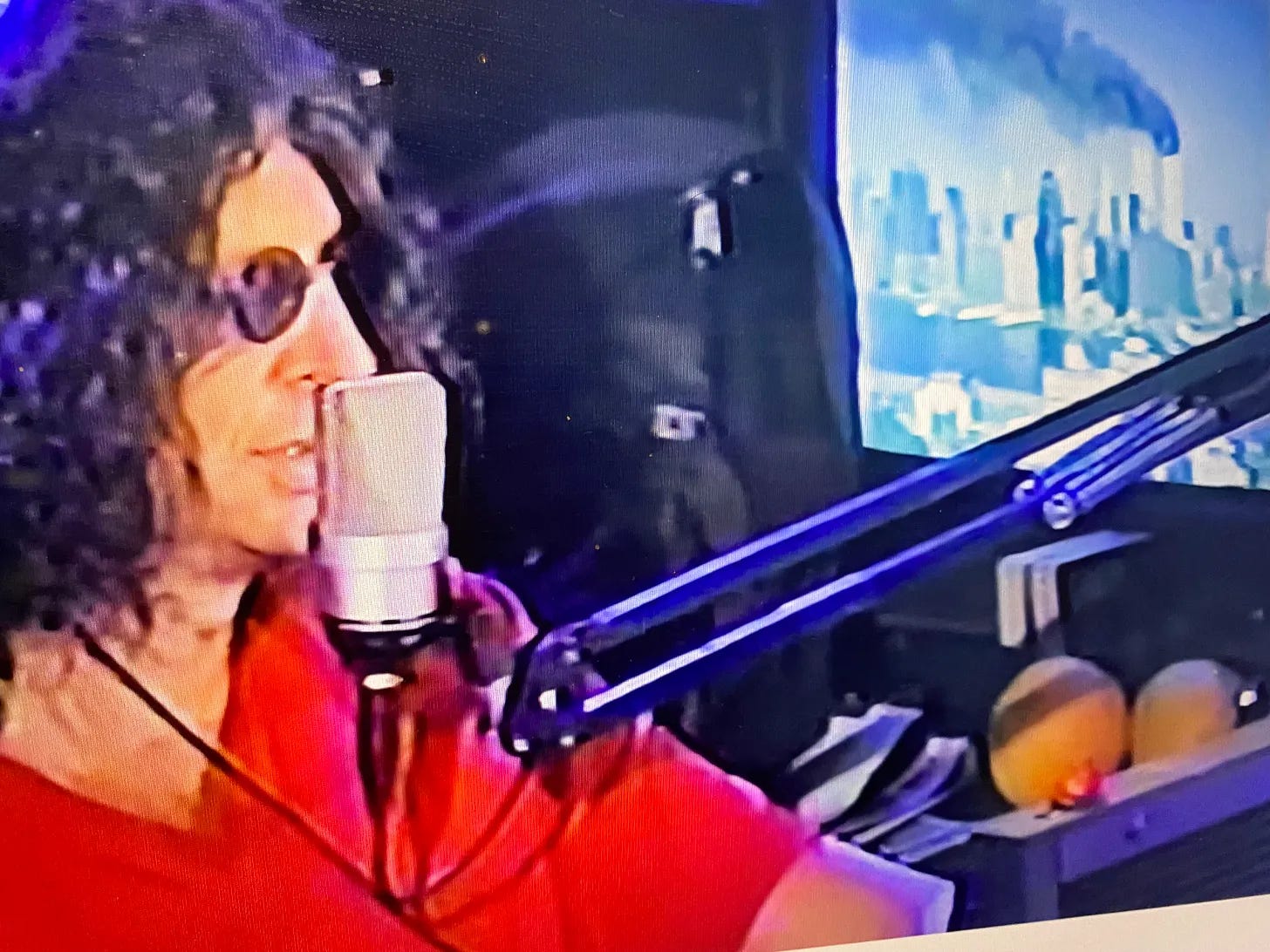
And he was right; within minutes, he and his crew were discussing Osama Bin Laden, who was among those responsible for the previous attack on the World Trade Center in 1993.
His very first question after learning of the first crash, while other newscasters were speculating it was a horrible accident, had been, “Was it a terrorist attack?”
Stern, broadcasting live from New York City, extended his radio show to continue his coverage of the events. A caller from a building right next to the World Trade Center described the chaotic scene unfolding outside as being, “Like Armageddon.”
Presciently, Howard suggested that the caller “ought to get out of there,” predicting that the fire would “burn the whole building down.”
Listeners continued calling into the show, allowing the self proclaimed King of All Media to provide incredibly unique, incredibly raw coverage of the incident unlike any other coverage of the events.
Many fans called in to thank Howard for remaining at his post, with several calling his coverage - which included live on the ground reports from his fans as well as media coverage from the major networks - better than the network media.
The Howard Stern show remaining on the air as the events unfolded live allowed New Yorkers, American citizens across the country, and even a Senator to share their observations, feelings, and perspectives with the rest of the United States and beyond in real time when there was no “social media” and only about half of adults in the United States were online.
Many Americans, more outraged than afraid, called for a nuclear response, even live on the air.


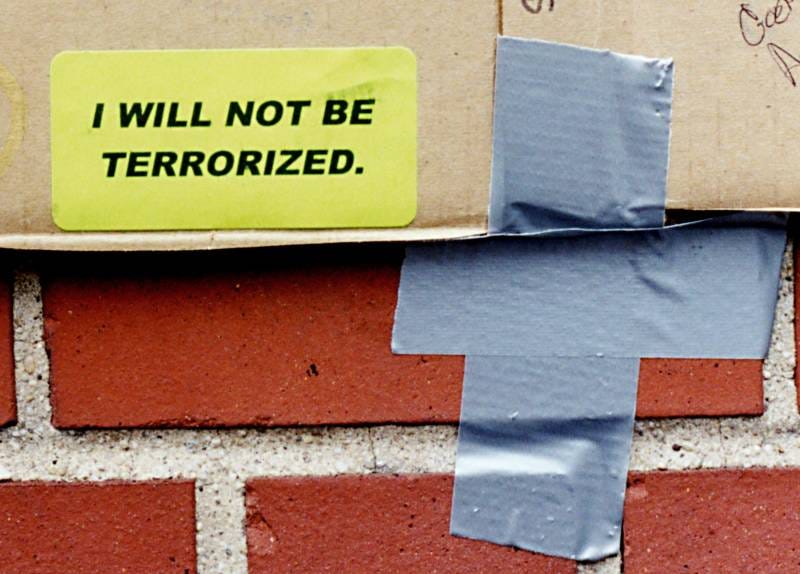
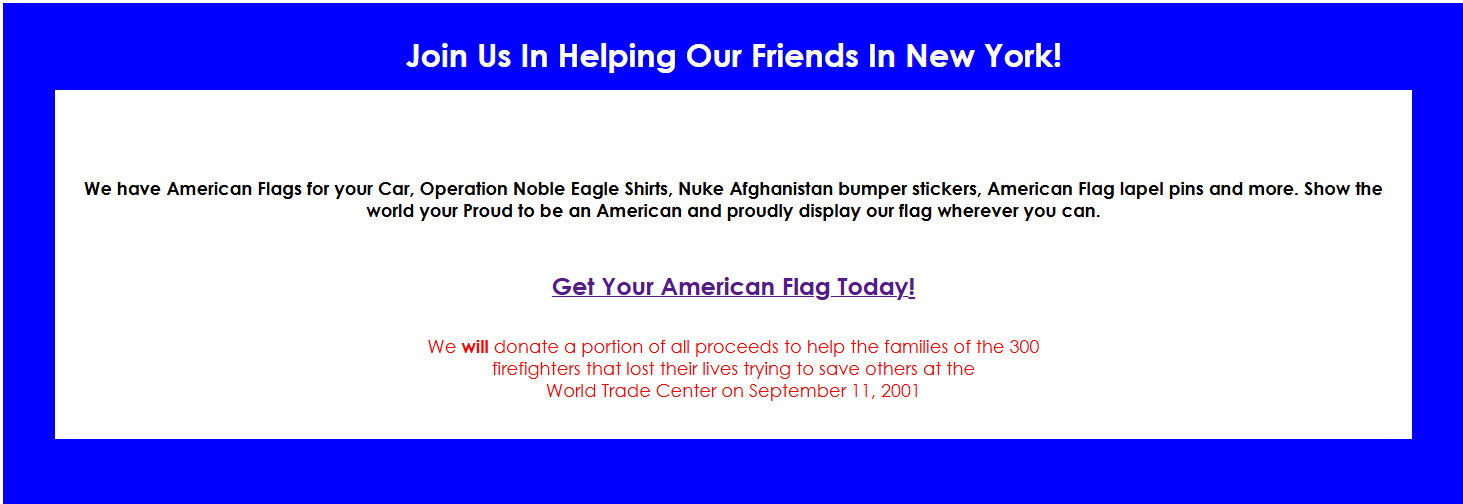
“Nuke Afghanistan,” along with "Glass the Middle East," and “Turn it to Glass,” highly inflammatory euphemisms, intended to evoke the aftermath of a nuclear detonation over desert sands such as the Trinity site in New Mexico, briefly became somewhat common expressions.


Sterns coverage is a fascinating look at raw history. Here, under Title 17, Section 107 of the United States Code, under the fair use exception, the September 11th coverage portion of this copyrighted work is presented without permission or payment for news reporting, educational, and historical research purposes.
Scott Rubenstein was able to capture some pictures from the inside of the South Tower as he made his escape.


A documentary about Rubenstein, Retracing 9/11, was released on YouTube in 2013.
As Howard Stern was asking “Was it a terrorist attack?,” Cyril Richard Rescorla was watching the North Tower burn from his office window on the 44th floor of the South Tower after hearing the explosion.
Like Howard, he was also watching the news coverage on the TV in his office. Unlike Howard, Rescorla knew damn well it was a terrorist attack.
Rescorla, a former British Army paratrooper and United States Army Colonel, was working as the Director of Security for investment bank Morgan Stanley.
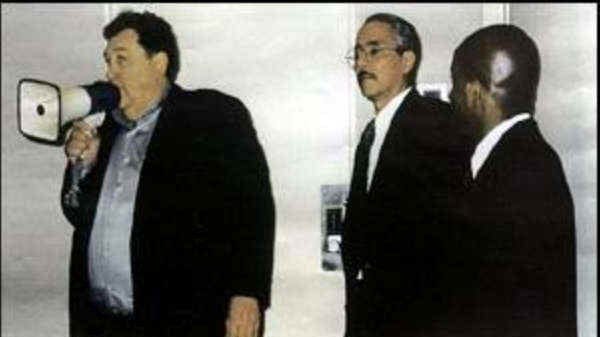
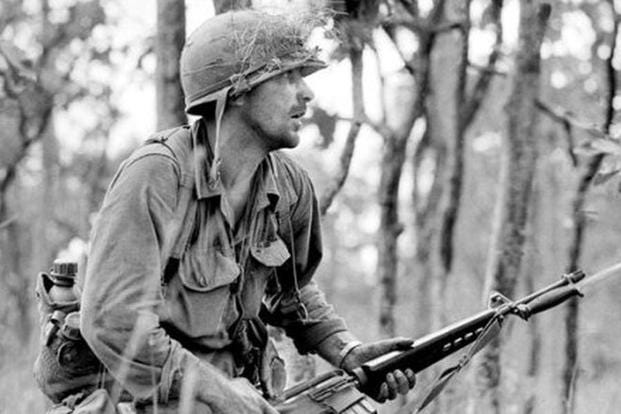
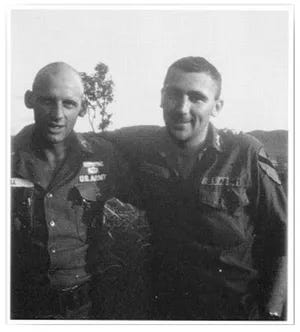
While watching the news speculate on whether this was an accident, he was on the phone with his long time best friend Dan Hill, who he had served with in Vietnam, Rhodesia, and the Belgian Congo.
Rescorla told Hill, "The dumb sons of bitches told me not to evacuate, they said it's just building One. I told them I'm getting my people the fuck out of here."
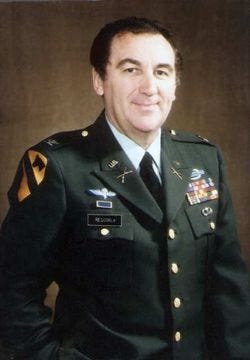
Rescorla and Hill together had predicted the 1993 World Trade Center bombing; their recommendations were ignored by Port Authority, which operated the site, and the bomb was set off less than 50 feet away from the load bearing column they said was a soft target.
After the bombing, Rescorla predicted a plane being flown into one of the Towers. Once again, he watched his premonition play out in front of him.
As a result of Port Authority failing to heed his warnings about the bombing and his premonition about weaponized airplanes, Rescorla decided that employees of Morgan Stanley, which was the largest tenant in the World Trade Center, could not rely on either the Port Authority or first responders in an emergency.
He subsequently forced all employees into a strict regimen of surprise fire drills, timing employees with a stopwatch and lecturing them on what to do in a fire.
Rescorla’s contempt for the Port Authority saved the lives of 2,687 Morgan Stanley employees in the South Tower, plus 250 office visitors, and another 1,000 or so Morgan Stanley employees from WTC 5.
Rescorla, who was dying of terminal bone cancer for which treatment involved painful injections directly into his stomach and prescription pharmaceuticals that dehydrated his body while simultaneously causing his body to retain fluid and swell from edema, reportedly kept morale up in the stairwell the same way he had during his service in Vietnam:
Singing Cornish war songs he remembered from his youth.
Men of Cornwall stop your dreaming; Can't you see their spearpoints gleaming? See their warriors' pennants streaming to this battlefield. Men of Cornwall stand ye steady; It cannot be ever said ye for the battle were not ready; Stand and never yield!
— based on the old Welsh song "Men of Harlech"
Between songs, Rescorla called his wife, Susan. He told her to stop crying, and that he had to get his people out safely. He also told her, "If something should happen to me, I want you to know I've never been happier. You made my life."
Susan replied, "You made my life, too," and then he was gone. Morgan Stanley occupied floors from 44 to 74, and evacuee’s made it down as far as the 55th floor before the explosion from United Airlines Flight 175 rocked the South Tower, obliterating floors 77 to 85 above them.
“We had no idea what had happened,” Morgan Stanley trainee Kevin Danni said in an interview. He was there on his first day of work. “The building shook violently, the walls cracked, and we knew that we had to get out.”
Danni spent the next 20 minutes in what he called “orderly chaos,” running down endless flights of stairs with his coworkers. By the 15th floor, the stairwells were filling with smoke, and by the 10th floor, several dozen firefighters passed them headed in the opposite direction, up the stairs, carrying a hose.
“They were so intent on getting to the flames, you could just see it on their faces,” said Danni, who was 10 blocks away when the tower collapsed about 30 minutes after his escape.
After successfully evacuating nearly all of Morgan Stanley's employees from the South Tower at 2 World Trade Center, Rescorla went to the 5 World Trade Center (WTC 5) building for the thousand or so Morgan Stanley employees scattered between the 1st and 42nd floors. Every single one of them made it out.
After evacuating WTC 5, he headed back into the South Tower with his security team to locate the 8 employees who were still unaccounted for. Rescorla and his team were last seen on the 10th floor of the South Tower, heading back up the stairs into the hellscape above.
When a co-worker suggested that Rescorla should evacuate too, Rescorla replied, "As soon as I make sure everyone else is out.”
Managers at Morgan Stanley called Rescorla’s emergency preparations a miracle that saved the lives of virtually everyone at the firm.
“He did a great job getting our people out… and then he went back in…” said Phil Purcell, former Chairman and CEO, choking back tears.
A biography about Rescorla, Heart of a Soldier, was published in 2002 by James B. Stewart, and Rescorla was also the subject of a 2005 documentary, The Man Who Predicted 9/11. Dan Hill died at the age of 76 on October 25, 2015; in 2014, Hill published a 722-page memoir, A Life of Blood and Danger.
As a result of one man’s selfless bravery, obstinate foresight, and contempt for those in charge, only 13 Morgan Stanley employees died in the September 11 attacks. Wesley Mercer, Jorge Valezquez, and Godwin Forde are known to have died alongside Rick Rescorla, sacrificing their lives in a heroic effort to save the lives of all of their colleagues.
Titus Davidson, a Jamaican immigrant and another Morgan Stanley employee, reportedly died in the collapse after going back into the building to help a woman in a wheelchair.
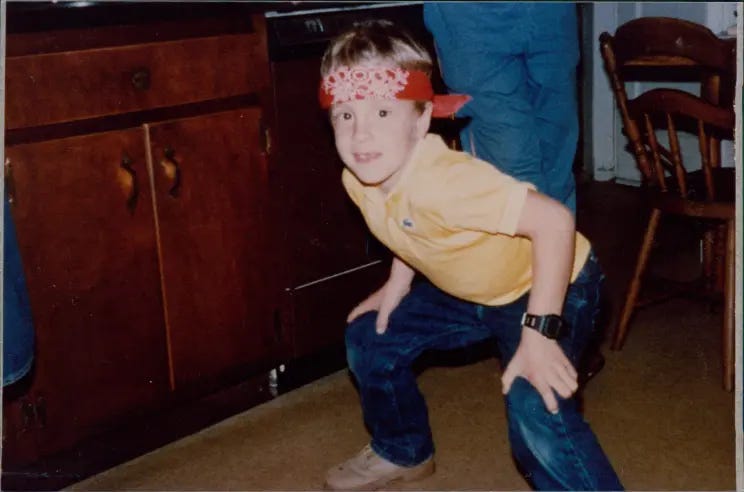
Welles Remy Crowther was in his office working as an equities trader on the 104th floor of the South Tower with dreams of becoming a firefighter when United Airlines Flight 175 crashed into his building at 9:03 A.M.
Crowther called his mother from his office at 9:12 A.M. and left her a message telling her that he was okay before making his way down to the decimated 78th-floor Sky Lobby, where he found a group of survivors including a badly burned Ling Young.
Young had been standing at the elevator bank when the plane hit the tower was one of only 18 people in the South Tower who escaped from within or above the impact zone where the plane hit the building. Some estimates place as many as 200 souls in the sky lobby at the moment of impact. Of those, 12 are known to have made it out alive, all thanks to Welles Crowther.
Crowther put Ling Young on his back, and directed the others to the only stairwell that hadn’t been destroyed, where they followed him down to the ground floor where he dropped off the woman he was carrying before heading back upstairs to the 78th floor. By the time he made it back to the Sky Lobby, he had his red bandana over his face in an effort to protect himself from the smoke and particulate matter.
Back in the Sky Lobby, he found another group of survivors, this time including Judy Wein, who was suffering from a broken right arm, cracked ribs, and a punctured right lung. Richard Gabrielle, a co-worker of Wein, was pinned to the ground, his legs apparently broken by marble that had fallen on them. Wein tried to move the stone to free him but Gabrielle cried out in pain, telling her to stop.
According to Wein, Crowther put out fires and administered first aid before making an announcement:
"Everyone who can stand, stand now. If you can help others, do so."
He brought this group downstairs as well, and as they headed for the street, Crowther turned around, and began climbing the stairs again. He was last seen heading upstairs with members of FDNY. The South Tower collapsed on them at 09:59 A.M.


Crowther's body was found in March 2002, alongside several other firefighters and other first responders, bunched together in what is suspected to have been an ad hoc command post in the South Tower.
Crowther's family was unaware of his rescue efforts between his last phone call to his mother and his death until Allison Crowther read Judy Wein's account in The New York Times of being saved by a man in a red bandana.
President Obama met with both Ling Young and Allison Crowther, honoring Welles Crowther and his red bandana at the 9/11 Memorial Museum.
Based on survivor accounts, Crowther, only 24-years-old, saved the lives of at least 18 people. A mostly completed New York City Firefighter application was discovered in his home after his death and, in 2006, Crowther was posthumously named an honorary New York City firefighter by Commissioner Nicholas Scoppetta.
Some of those saved by Crowther were also saved by another man: Ronald Carl Fazio, Sr. He was working on the 98th floor, and like Rescorla, knew that leaving was the right move. He spent his last moments trying to help others, including getting them to evacuate after the first plane hit, and is remembered for literally holding the door open for them as they made their way to the stairs.
One co-worker reportedly told him he needed to calm down; reportedly, that co-worker died. Fazio’s wife, Janet, heard countless stories of her husband’s bravery.
“He went back in, after he held the door for so many, he went back to the other side of the building to tell them to get out, too,” she said. He was last seen outside of the towers.
Based on cell phone records, the Fazio family knows that he lent his phone to a man to call his wife. That woman later thanked the Fazio family — because of Fazio, she got to tell her husband that she loved him one last time.
Fazio apparently stayed at the site to continue helping, never crossing the street to get clear of the building and insure his own safety. Around 9:00 A.M., while he was on the phone to his wife, the phone went dead. The family's best guess is that he was killed by debris when the Flight 175 slammed into the South Tower. His remains were never recovered.
Before they knew what had happened, when they were posting missing persons flyers in the hopes that he might be alive, Fazio’s adult children felt compelled to staple Reese’s Peanut Butter Cup packages, his favorite candy, to the flyers. They wrote that they had Reese’s waiting for him, and captioned the bottom, “If found, please feed Reese’s Peanut Butter Cups.”
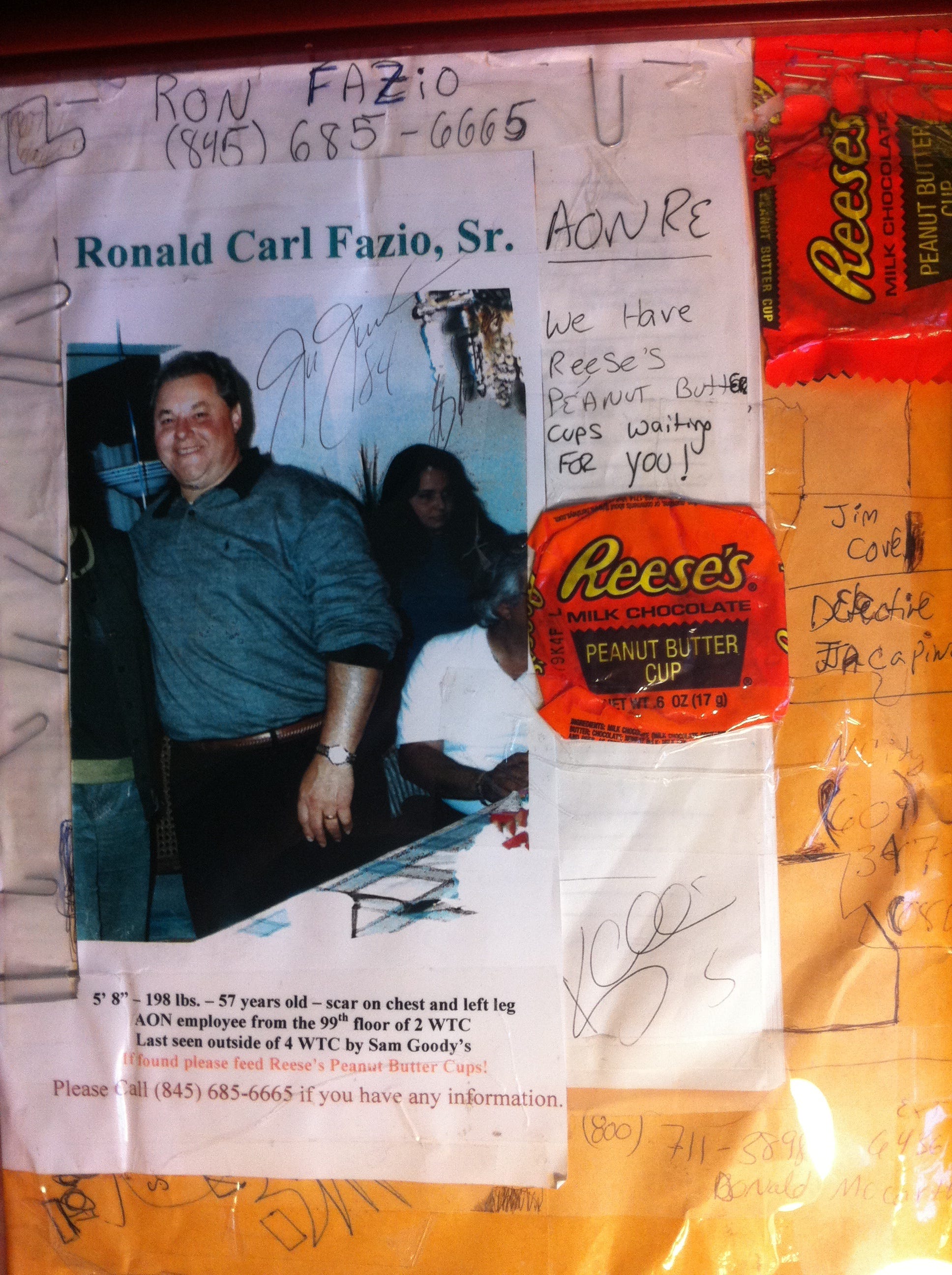
His family founded Hold the Door for Others in his honor, a nonprofit that provides resources to inspire people to grow in healthy ways when faced with adversity. His family still leaves Reese’s cups by his name at the 9/11 memorial.
Unlike the South Tower, where Welles Crowther was able to navigate down from the 104th floor, 1,356 people were cut off from escape above the impact at the 92nd floor where Flight 11 hit the North Tower. All three of the building’s stairwells were destroyed and made impassable by the crash. The only way out was through the windows.
The Falling Man is a famous and controversial photograph taken by an Associated Press photographer, Richard Drew, that shows a man falling from the upper floors of the North Tower at 9:41:15 A.M.
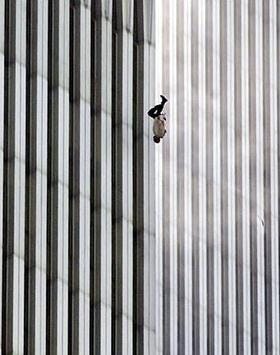
It is unclear whether he fell or jumped to escape, and his identity officially remains unknown, but it is suspected that the man is Jonathan Briley, a 43-year-old sound engineer who worked at Windows on the World, a restaurant on the 101st floor of the North Tower that was celebrating its 25th year in 2001.
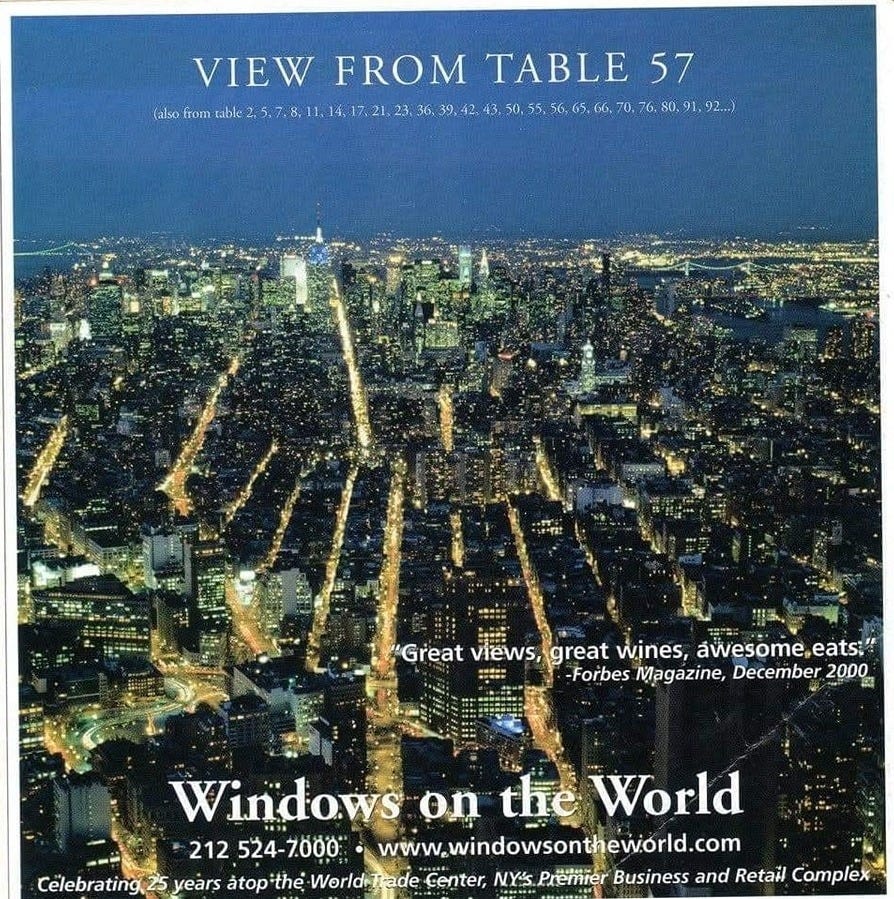
Jonathan Briley was the brother of Alex Briley, a founding member of the band Village People. His other brother, Timothy, believes that the photo is of Briley, and Briley's older sister Gwendolyn told The Sunday Mirror,
"When I first looked at the picture… and I saw it was a man — tall, slim — I said, 'If I didn't know any better, that could be Jonathan.'"
Michael Lomonaco, the restaurant's executive chef, also believed that the man looked like his employee Briley. Lomonaco was the only survivor from the staff at Windows on the World; he happened to be in the tower's lobby during the attacks, and was evacuated from the building. No one who was in the restaurant survived, including Neil D Levin, executive director of the Port Authority.
The last people known to leave the restaurant include Michael Nestor, deputy inspector-general of the Port Authority of New York and New Jersey, and one of his investigators, Richard Tierney. They left around 8:44 A.M. for a meeting; Flight 11 crashed into the building just 2 minutes later.
Melissa Harrington-Hughes called her father from Windows on the World about 10 minutes after American Airlines Flight 11 hit the building. She had been there for a business meeting. Her father, who still visits her grave several times a week, asked her if there was a lot of fire.
“She said no, but there is a lot of smoke," Harrington told NBC Connecticut, adding that he turned on the TV in his West Springfield, Mass home to see what was going on. His daughter told him that either a plane had hit the building or a bomb had gone off; she wasn’t sure.
“I told her I love her, she told me she loves me and she said you got to do me one favor and I said what’s that? She said you gotta call Sean, because the phone's not on because it’s San Francisco."
Sean was her husband. She had called him before she called her dad, but he was sleeping, and missed her call. She left him a message at 9:07 A.M., which the family still keeps a copy of.
“Sean, it’s me,” Harrington-Hughes said in her voicemail. “I just wanted to let you know I love you and I’m stuck in this building in New York. There’s a lot of smoke and I just wanted to let you know that I love you always.”
Her message to her husband is how her father believes she should remembered.
“She was so unselfish. She didn’t think of herself, she thought of her husband," Harrington said, adding that the message had made his daughter a cult hero who the world fell in love with.
In 2019, journalist Tom Roston detailed the story of another victim in the restaurant and the wife he left behind: an illegal immigrant from Ecuador named Luis Alfonso Chimbo.
Chimbo had been promoted to receiving manager earlier in 2001, working his way up from stock boy. In August, his wife Ana Soria had a miscarriage, and he took time off of work to help take care of her. September 11th was his first day back on the job, and he left his house before 6 A.M. for a job that he reportedly loved.
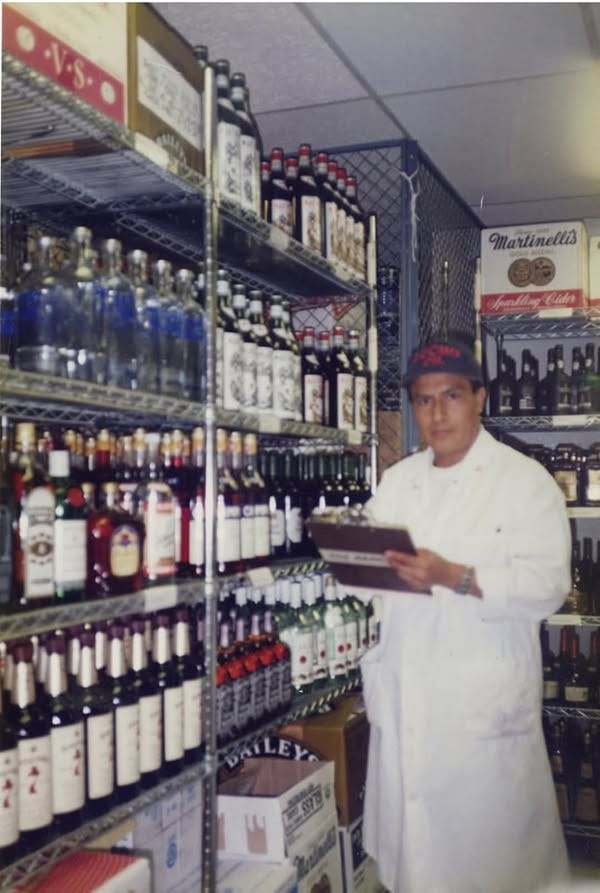
His wife Ana Soria, also an illegal immigrant from Ecuador, was able to secure a green card in 2016. In June of 2018, the widow visited the north reflecting pool to honor her husband on his birthday. She brought a birthday card with a note that read, “To the love of my life, happy birthday to you. Surprise, you didn’t know I was coming.”
She sat there for hours, watching visitors open her card and read it. Some openly sobbed. As dusk began to settle over the memorial, Soria was hoping for a moment alone to sing “Happy Birthday” to him. As she waited, she was started when four college-aged women read the card and began to sing to him.
She went over to thank them, saying, “Thank you so much. Thank you.” They asked her how she was related to the memorial, and she told them, “He was my husband. I was going to sing to him.”
The young women asked Soria if they could sing together, and they sang and cried together together.
“I felt peace in my heart,” she told Roston.
Doris Eng, club manager for Windows on the World, called the fire command center after the impact to ask what they should do. The WTC fire policy called for the immediate evacuation of any floor that was on fire plus the one above it. Others were only supposed to evacuate when directed by the fire command center, or failing that, “when conditions dictate such actions.”
“There's not much you could do other than tell them to go wet a towel and keep it over your face,” according to Alan Reiss, former director of the world trade department of the Port Authority.
Except that the plane had severed the water line to the upper floors. A waiter, Jan Maciejewski, told his wife by cell phone that he couldn’t find enough water to wet a rag, telling her he was going to check the flower vases.
Glenn Vogt, the general manager of Windows on the World, said that about 20 minutes after the plane hit, his assistant, Christine Olender, called him at home. She got his wife instead because he was on the street outside the World Trade Center. Olender told Vogt that the conditions inside the restaurant were quickly deteriorating. They still hadn’t been told to evacuate.
“The ceilings are falling,” she told him, “the floors are buckling.”
Laurie Kane, the wife of the restaurant's comptroller, said she could hear someone screaming “We're trapped,” as she finished the last conversation she’d ever get to have with her husband, Howard.
Stephen Tompsett, a computer scientist who was at the WTC for an IT conference, emailed his wife, Dorry, using his BlackBerry, asking her to “Watch CNN.” He wanted her to email him with information on what was happening because the people trapped on the upper floors, “Need updates.”
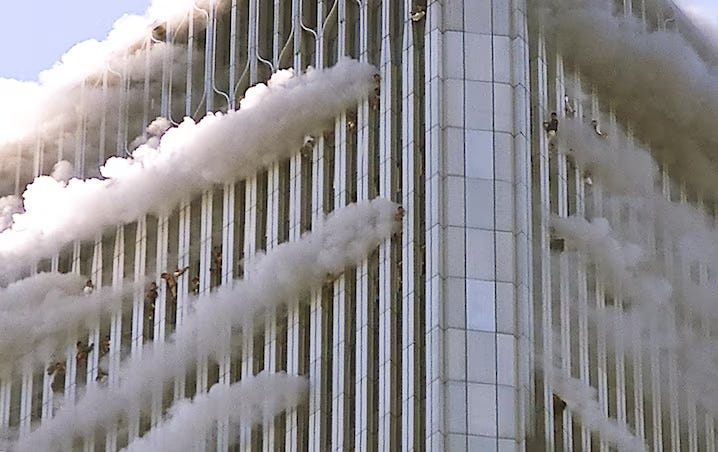
The photograph below shows the level of confusion and desperation that people like Stephen Tompsett, Melissa Hughes, Doris Eng, Howard Kane, and Jonathan Briley felt - people trapped in the upper floors of the North Tower - breaking through windows, hanging outside of the building and clinging to the outer facade to escape the intense smoke and heat a quarter of a mile up from the ground below.
Kelly Reyher, a survivor from the upper floors of the South Tower, said that although he saw people intentionally jump, he also saw people who fell because they couldn't see or breath and were looking for fresh air and to figure out what they were looking at in the unfamiliar carnage surrounding them.
Rajesh Mirpuri called his company, Data Synapse, coughing like mad, and told them he could not see much of anything for all the smoke in the air. Stuart Lee, a Vice President at Data Synapse, emailed his office in Greenwich Village:
“An argument going on as to whether we should break a window. Consensus is no for the time being.”
This didn’t last long as they struggled to breath. Soon, people began to poke out through broken windows along the west face of the restaurant. Glenn Vogt could see them from the ground silhouetted against the smoke.
“About five floors from the top you have about 50 people with their faces pressed against the window trying to breathe,” a police officer in a helicopter reported. Other photographs depict the same scene with other victims.
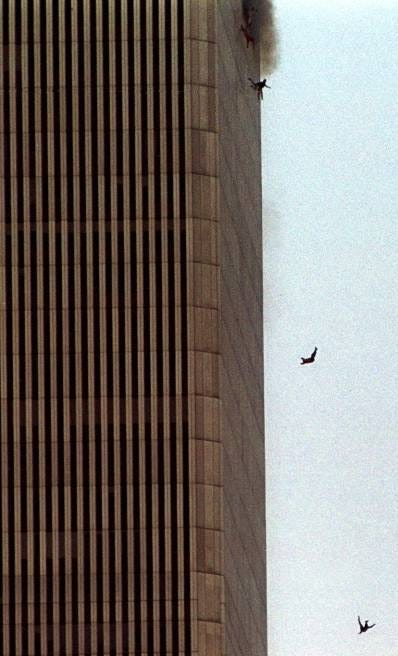
"As we watched in stunned horror, you started to see people walk up in the hole of the building with their hands over their faces… The hole was two to three stories," said Reyher. "The first guy was in a blue shirt and jeans and he walked up to the edge with his arm over his face and just fell."
Reyher was saved through an unlikely device: he stepped into an elevator just as a plane crashed into the South Tower. Unlike in the North Tower, one of the South Tower’s three stairways remained passable. Stairwell A was in the South Tower’s northwest corner, as far as it could have been from the impact, from which it was also reportedly shielded by a large row of Otis elevator machines, which helped protect the stairwell, as well as Kelly Reyher. They were directly in front of the same 78th floor sky lobby where Welles Remy Crowther rescued two separate groups of survivors, as was Reyher.
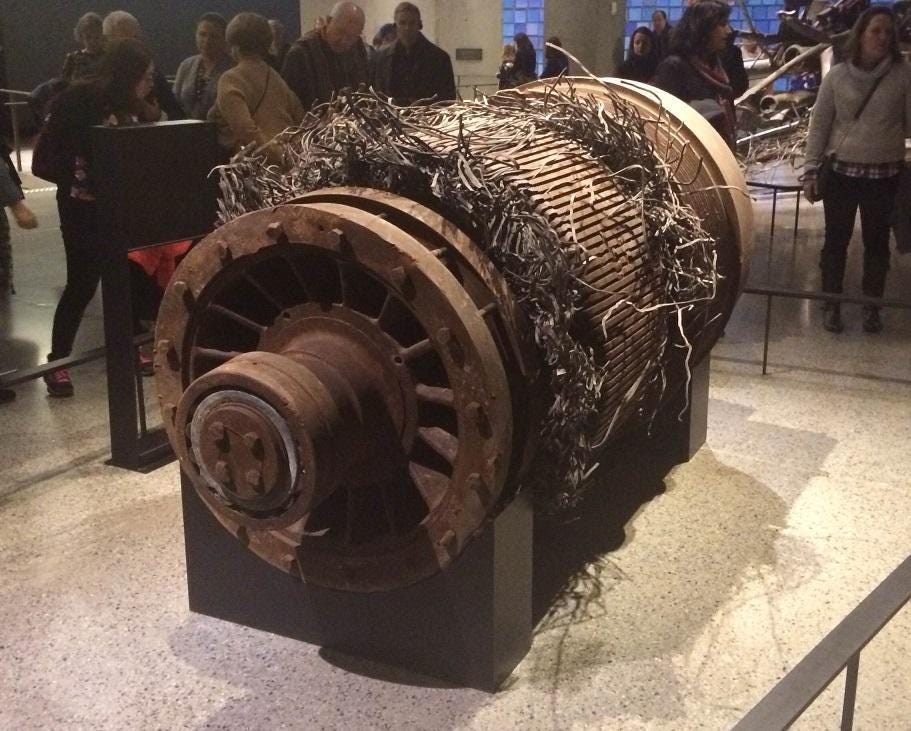
The 8 ft by 13 ft, 10,000-pound Otis elevator hoists had tens of thousands of pounds of counterweights were bolted to floor beams twice as big and four times as heavy as those of other floors.
Some were found intact in the Pile, the colloquial term used to describe the wreckage at Ground Zero, still bolted to the reinforced beams.

Most of the people who escaped via Stairwell A were in the north side of the crowded 78th floor sky lobby, where people transferred from elevators local to the upper floors to express elevators that went all the way down.
The Twin Towers were the first skyscrapers to have an elevator system like this. Each tower had 99 elevators that included freight, local, and high-speed express cars.
Despite the protection the machines offered that allowed some people to escape, it is believed that hundreds of people died either inside elevators or as a result of fuel-air explosions coming from elevator shafts below the point of impact.
Hundreds of people also died when the explosion from the impact ripped through the sky lobby, which was "packed worse than lunch or rush hour," said Judy Wein, a survivor whose arm was shattered.
Donna Spera was waiting for an elevator on the 78th floor of the South Tower when the plane hit. She was in the process of making her way back to the 100th floor where her office was.
She and her coworkers had fled after Flight 11 exploded in the other tower, but turned around after the announcement Rick Rescorla treated with contempt and derision came over the building’s PA system announcing that the building was safe and people should return to their desks.
Spera was directly in the impact zone of the Flight 175 crash as a result of where she was located. She was thrown across the floor by the force of the explosions, which killed people immediately around her.
The force of the impact was such that some landing gear was found on Rector Street, five blocks away, and a mostly intact engine was found at the corner of Church and Murray three blocks away.
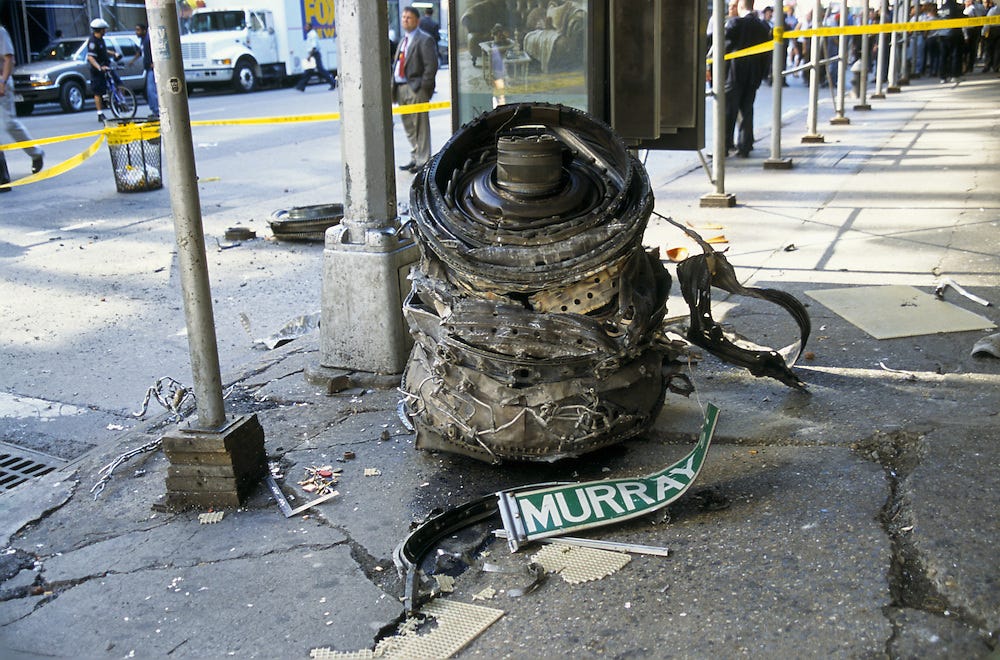
She sustained first, second, and third degree burns, as well as bruising and a broken hand. She walked down 78 floors guided by Welles Crowther, the Man in the Red Bandana.
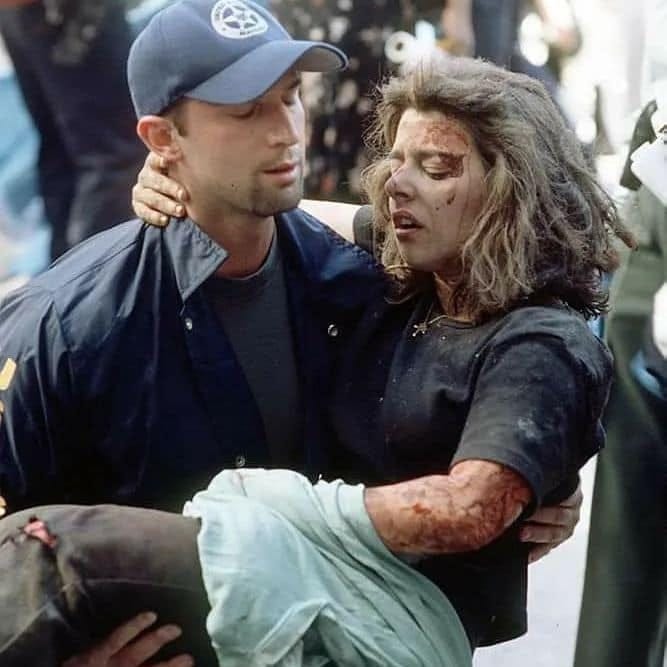
Kelly Reyher, a lawyer who worked near the top floor, crawled out of a burning elevator and over corpses in the lobby on the 78th floor to reach Stairwell A. None of the survivors who made it down Stairwell A would realize how lucky they were until later.
"There were no bodies or anything in the staircase," Reyher said.
Reyher told CBS News in 2002 that he decided to go back up to his office to get his palm pilot because other people had already gone back up and, given the announcement that it was safe, he figured it was safe. Flight 175 crashed into the building right as he stepped into the local elevator on the 78th floor.
"You didn't know what it was then, other than it was a huge concussion blast with a searing sort of heat wave. It sort of blasted me to the back of the elevator and it visibly crumbled. The side was split wide open and you could see in the shaft door and the floor buckled. The doors were sort of bent," Reyher told CBS.
"I realized I was trapped in an elevator and thought what a stupid decision to get in an elevator," he said, adding that he thought that he was going to die, trapped in a small box 78 floors up from the ground.
"A fire was raging in the elevator shaft and since it had split, you could see it and the flames were starting to come in the elevator," he said. "Ashes and hot smoke were coming in, rising to the top and through the floor. I wasn't in a state of panic. I thought this is it.”
“I realized what was happening in trade center one as the flames came in and the hair was getting singed off of my arms and head. I thought, if I stand up, maybe I will asphyxiate and pass out and not know that I'm going to burn to death."
"[The elevator doors] were mangled, but I was able to pull the inner door and the outer door with my briefcase," he said, adding that he also used his briefcase to protect himself as he crawled into the lobby.
"When I got there, I went into a little alcove and the flames were shooting into it and facing me. There was about a foot of debris on the floor. As I wiggled my body, I tried to stand up. The smoke was so hot that it just about closed my throat and I put my shirt over my mouth to try to breathe. I was trying to figure out where the staircase was in the lobby I had been in. As I crawled along and as I came from the alcove into the Sky Lobby, that's when the magnitude hit me. There were bodies everywhere. It was deathly quiet, except for people screaming and moaning and you could only see 10 or 15 feet. As I crawled, I checked to see if some people were alive, but they weren't.”
“There was one woman who was up on her knees saying, 'Please, don't leave me' and we got her over to the stairs. As soon as I got there the door opened and I saw someone was there and I found two of my colleagues who were alive. Both were very injured, bleeding, limping and burnt."
The woman was Donna Spera, and the person who emerged from the stairwell into the lobby was Welles Crowther.
"As we got into the stairwell, you couldn't see much because it was full of smoke and the question was whether to go up or down. Because no one knew where the fire was, some people made the decision to go up because some people were yelling that the stairwell was blocked below. It was blocked because the wall and ceiling had come down. But, it wasn't so blocked that with good strong hands you couldn't move it. So that's what we did and we started to dig the debris and help other injured through the debris, about five people in all."
"We went down 78 flights of stairs and got out of the building... I sat there on the curb and finally looked up to see what was happening and listened to people on the ground saying what happened, because we didn't know.”
Reyher wasn’t the only one. Gigi Singer walked down from the 78th floor, as did Edward 'Ed’ Nicholls. Nicholls can be seen being helped by Officer Moira Smith, who helped many people, credited with saving hundreds of lives. She was directing people from an escalator out of the South Tower when she learned that a woman was having an asthma attack, and made her way up to offer her help, reaching the third floor before the South Tower collapsed down on top of her.


Smith witnessed American Airlines Flight 11 crash into the North Tower and was the first police officer to report the incident; she called the Communications Division so they could notify others.
She is also the only female officer who died in the line of duty on September 11. NYPD Sgt. Mary Young was quoted speaking about Smith in the book Women at Ground Zero by Susan Hagen and Mary Carouba, saying, "Nothing could have stopped her from running into that building to help save lives on September 11. Nothing."
Moira Smith, 38, was survived by her husband, Jim Smith, also an NYPD officer, and their then-2-year-old daughter Patricia. Three months after her death, Moira was posthumously awarded NYPD's Medal of Honor, and in 2012 a playground in Madison Square Park, where Smith regularly patrolled, was re-named the Moira Smith Playground in her honor.
Jim reportedly saw the South Tower fall on his way into the City from around the Midtown tunnel. He said that he was told Moira was safe multiple times when he arrived at the 13th precinct where they both worked, but that hours later, after he had worked the Pile of rubble himself for hours searching for survivors, he was told his wife was unaccounted for at around 3 A.M., and was "under the building."
"There is a voice recording of her, calling for help," Jim said, where "[She said] that she was on the third floor and couldn't breathe and needed help. That was the last thing we heard from her."
Lt. Rolando Pastrana told WFAA that he heard Moira's voice over the police scanner, and that it was one of the most traumatizing parts of 9/11 for him:
"I just remember her screaming over the radio: '[I’m] stuck,’ 'I can’t get out.' I just heard her screaming and then the transmission stopped."
In March 2002, Moira Smith's remains and personal effects were recovered from the Pile, and her NYPD shield was donated to the National 9/11 Museum at the World Trade Center by her husband.


Brian Clark, a 54-year-old executive vice-president at a brokerage firm on the 84th floor, chose stairwell A randomly. Ron DiFrancesco, then 37, was with Clark when they met people coming up the stairs at the 81st floor who claimed that there was fire and smoke below blocking the way.
While the group debated what to do, Clark grabbed DiFrancesco and entered the 81st floor to look for someone they could hear screaming for help through the door. As Clark and DiFrancesco entered the floor, Clark noticed his coworkers as they started to go up the stairs to the roof instead of down. This group never made it out; access doors to the roof were locked, and it’s unknown what happened to them. There were no plans for helicopter rescues from the roof, which would have been unsafe due to dense smoke.
As Clark and DiFrancesco made their way to the voice screaming for help, DiFrancesco became overwhelmed by the smoke and returned to the stairs, which he also took towards the roof. Unlike the rest of his coworkers who went up the stairs and died when the building collapsed, DiFrancesco went up to the 91st floor, found the doors locked, and turned around to head back down the way he came.
“I was panicked,” DiFrancesco told NYMag in 2011. “I wanted to see my wife and kids again.”
He barely made it out. DiFrancesco said that some force or spirit led him back down the stairs, even encouraging him to get up and walk through the fire blocking his path to keep heading down to safety. The voice in the darkness guided him the whole way down, encouraging him with words until he made it outside.
Back on the 81st floor, Clark found the person who was screaming for help, following the voice using his flashlight to navigate the chaos. It was Stanley Praimnath.
Clark determined that the only way out was for Praimnath to climb over a wall that had been decimated by the crash. Praimnath wasn’t sure he could get over the wall, but Clark encouraged him to try, so he did, repeatedly, even injuring his hand. Finally, Clark managed to get his arms around Praimnath body.
“I pulled him over the top and we fell in a heap and hugged,” Brian said in an account he gave to the New York Times. Once Clark and Praimnath were both on the same side of the wreckage, they made their way to the stairwell.
Clark told Praimnath about the group who claimed the stairwell was impassable, but the men decided they wanted to see for themselves. Maybe it would be like the wall Praimnath had just climbed over.
Their story suggests they may well have been the first people to make their way down. As they descended the stairwell, they encountered some smoke and some debris, but the two men were able to either move the debris or climb through it, and continue down the stairs. In Brian’s own words:
Some of the firewall, or maybe it had come from ceilings, I don't know, had blown in on the stairs. Sheets were lying, or leaning on angle up against the railing. So we had to move those. Some were lying on the stairs. Water seemed to be dribbling out somewhere, I don't know where, and making the stairs wet. And it was running sometimes on this drywall that was lying flat on the stairs making it like a slide. So we had to be very careful. We were holding onto the railing, hand-over-hand, kind of going down those slippery areas because we were standing on slippery drywall.
Somewhere around the 77th floor, the stairway walls were cracked, and you could look through the cracks and see flames. They were just quietly licking up, not a roaring inferno. And there was some smoke there, but again I think the stairs were pressurized, pushing the air out so we had less smoke in the stairway than you might imagine…
…On the 31st floor … We got into a conference room or something. I called home, told my wife that I was fine. Stanley called home. I don't believe his wife was home. And I called 911 and I had quite a session getting through to somebody who would actually take my message.
Brian was trying to inform emergency services that Stairwell A was clear and could be used to rescue the people trapped at the top of the tower.
I mean, there were some real delays there, very frustrating. I finally sort of read them the riot act and said, ``Look, I'm just telling you this once, don't put me on hold because I'm going to hang up when I'm finished.''
And I did that and we left.
Clark and Praimnath made it out about five minutes before the building collapsed, but the tower collapsed just as DiFrancesco walked outside. He said the last thing he remembers is seeing a large fireball before waking up three days later with extensive burns and a head laceration.
Clark and Praimnath witnessed more of the carnage.
We stopped at a deli. That's the first stop. And I asked the deli owner, I said, do you have water? And he said, yeah, sure. They were just staring up at the towers. So he went in and came out with some water and a breakfast platter: sliced cantaloupe and sweet rolls and the cellophane. And he said, “Here, nobody's coming for this today.”
…We walked to the west side of Trinity Church. There's a bridge there that comes out of the backside of the church…
We walked around the south side of the church, but halfway up the hill on Rector Street, we stopped and looked up at the burning Trade Center towers. Stanley said he thought the tower might fall down.
I said, “No way. That's a steel structure.” I didn't finish the sentence when it started to slide down. And we stood looking at it while it did it. And we stood staring but not believing quite what we were seeing. And at that time, I thought only the top third of the building had fallen. We didn't run immediately because we didn't realize this dust debris was rolling down the street. It wasn't until it kind of went literally up and over the church, that's when we started to run.
And I still had the darn fruit tray, the breakfast platter. I felt like an idiot when I realized I had it in my hand, but I'm running down Broadway holding the thing. You're not thinking. We ran down Broadway to 42 Broadway, dove into the lobby, and stayed there for 45 minutes.
Before the towers collapsed…
John Patrick O'Neill, an American counter-terrorism expert who had previously worked for the FBI, was working as hard as he could to evacuate the South Tower.
His story is one of those told in the Pulitzer prize winning book The Looming Tower: Al-Qaeda and the Road to 9/11 by Lawrence Wright which was also made into a documentary for Hulu.
O’Neil had only just taken the job as head of security at the World Trade Center on August 23, 2001. He died at the age of 49 evacuating others from the South Tower.
O’Neill was driven by this kind of all-consuming desire to protect his fellow Americans, according to his biography, The Man Who Warned America.
As an FBI agent, O'Neill was involved in virtually every major American terrorism investigation of the 1990s, including the bombing of the Alfred P. Murrah building in Oklahoma City, the Khobar Towers bombing in Saudi Arabia, and the attack on the USS Cole in Yemen.
In 1995, O'Neill was involved in the capture of Ramzi Yousef, the mastermind behind the 1993 World Trade Center bombing. In late August of 2001, he talked to his friend Chris Isham about the job at the World Trade Center.
Isham reportedly said, "At least they're not going to bomb it again."
To which, O'Neill prophetically replied, "They'll probably try to finish the job.”
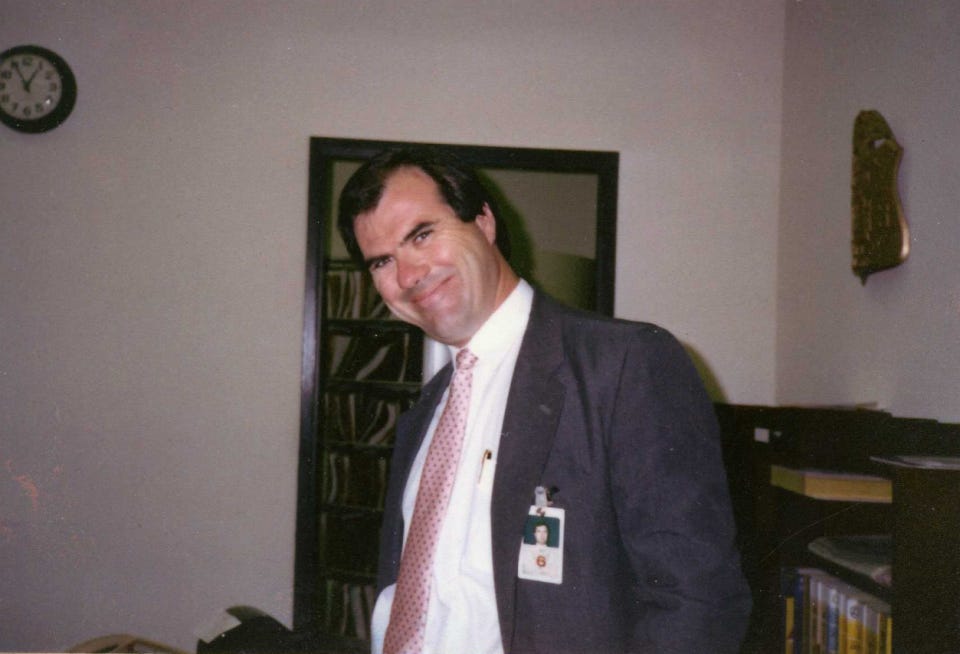
In 1999, O'Neill, a supervisor at the FBI, assigned Mark Rossini to work as the FBI liaison in the CIA's Bin Laden Issue Station in Virginia. O'Neill had a conflict with the CIA station chief, Michael Scheuer, and wanted Rossini to feed him information about what the CIA was doing.
Rich Blee, who had been appointed by CIA chief George Tenet to head of the Bin Laden Issue Station, wanted Rossini out working in the field instead of meddling in CIA business.
When the Bin Laden Issue Station learned that bin Laden associates Nawaf al-Hazmi and Khalid al-Mihdhar were headed to America with valid visas, Rossini attempted to alert O'Neill, but Blee blocked the message.
Mihdhar and Hazmi were two of the hijackers of American Airlines Flight 77. Michael Anne Casey, a CIA staff operations officer, blocked a draft cable to the FBI written by Doug Miller, another FBI agent assigned to the Bin Laden Issue Station, warning that al-Mihdhar had a multiple-entry American visa.
Rossini testified that Michael Anne Casey also verbally ordered him to not share information about al-Mihdhar or Nawaf al-Hazmi with the FBI.
Alfreda Frances Bikowsky was a senior staff member at the Bin Laden Issue Station in January 2000 and the direct supervisor of Michael Anne Casey.
After the towers collapsed…
Bikowsky told congressional investigators in 2002 that she hand-delivered al-Mihdhar's visa information to FBI headquarters; this was later proven false by FBI visitor log books which did not contain any trace of her alleged visit.
Bikowsky married another former CIA officer, Michael Scheurer, in 2014, and retired from the CIA in 2021, still proud of her participation in the CIA's rendition, detention, and interrogation by torture program run in the years immediately after 9/11 in which she tortured one man because his name kind of sounded like a terrorists.
Scheurer was the first head of the CIA Bin Laden unit; Alfreda worked for him until 2004, when he left the agency. He “anonymously” published Imperial Hubris in 2004, in which he calls for the United States to either disengage from the Middle East completely or prepare for a full-scale war against radical Islam (which, by 2004, was already well under way). In 2009, he accused any and all Americans who support Israel of “treason.”
In late 2014, the same month he married Alfreda, Scheurer published a blog post on his site that multiple news and media outlets interpreted as endorsing the assassination of President Obama and British Prime Minister David Cameron.
In an interview with The Hoya, he was quoted saying, “At some point, when push comes to shove, you kill people and get them out of the way.”
In an interview with BuzzFeed News, Scheurer said he was not endorsing the assassination of the President, and instead was arguing that people have to take action when a government becomes too repressive.
Scheurer also told Buzzfeed he believes the United States should encourage a Sunni-Shiite war:
“They love to kill each other more than they love to kill us. I would stoke it. It would distract them from attacking us.”
“I think that’s a crackpot idea,” former Deputy Assistant Secretary of State for Near East Affairs David Mack said when asked about Scheuer’s theory. “I don’t see it as something that would serve US interests.”
He is reportedly not liked by other CIA veterans. “He’s a complete fucking nut,” one told Buzzfeed.
Scheurer later reportedly became a QAnon supporter, and wrote in 2020 that “loyal Americans know their domestic enemies, as well as their locations, in detail, and will be able to act swiftly to eliminate them and the threat they pose.”
In 2023, he went on a podcast where he argued that American Jews are disloyal and "must be stopped and then scoured from the continent."
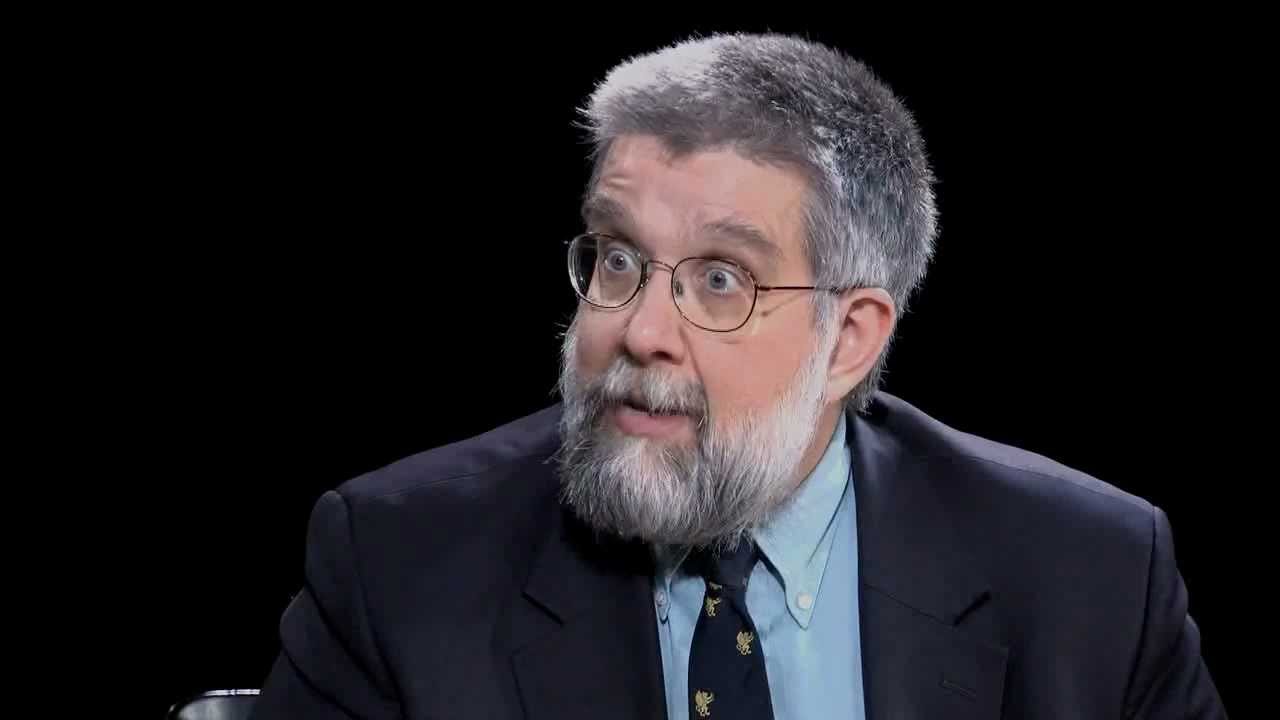
After being dubbed "The Queen of Torture" by a New Yorker profile, Scheur’s wife Alfreda re-emerged from her retirement as a “life coach for women” calling herself “Freda.”
Neither were ever held accountable for withholding information that could have potentially saved the lives of thousands of Americans, or for lying about it.

Another FBI colleague who was frustrated by the CIA, described as having a close working relationship with O’Neil, was Ali Soufan. Lawrence Wright wrote “Unfortunately, we have only one Ali Soufan. Had American intelligence listened to him, 9/11 might never have happened.”
Soufan is a Lebanese American born into a Sunni Muslim family in Beirut in 1971. After reportedly applying to the FBI on a dare from some friends, he was one of only eight FBI agents in the entire country who spoke Arabic at the time of the September 11 attacks, and he was stationed in the New York City field office.
According to a Frontline interview, Soufan was hired two years after the fateful dare, in 1997. One of his first official assignments was to write a report about Osama bin Laden.
ALI SOUFAN: And I gave it to my supervisor, and that paper ended up with John O'Neill [sic]. And it was about the threat that bin Laden will cause for the United States.
John O’Neil reportedly took Soufan under his wing. While in Yemen working on the September 11th investigation, Soufan learned that the CIA had been withholding information from the FBI.
According to The New Yorker, "Soufan received the fourth photograph of the Malaysia meeting—the picture of Khallad, the mastermind of the [USS Cole bombing]. The two plots, Soufan instantly realized, were linked, and if the CIA had not withheld information from him he likely would have drawn the connection months before September 11th."
Previously, during a 1999 investigation into al Qaeda’s Millennium Bombing plot in Jordan, he found an ignored box of documents from Jordanian intelligence sitting on the floor of the local CIA station which had maps showing the bomb sites.
His find "embarrassed the CIA", according to a 2006 New Yorker profile of him written by Lawrence Wright. Soufan resigned from the FBI in 2005, publicly chastising the CIA over his frustrations that the CIA had not been sharing vital information with the FBI.
He was also frustrated by the CIA interrogation tactics championed by Alfreda “Freda” Frances Scheurer nee Bikowsky, which came out after he testified in front of the Senate Judiciary Committee for its hearing on torture. He also published an Op Ed in the New York Times in 2009.
A 2008 Department of Justice Inspector General Report on the subject quotes FBI sources stating that "[Terror suspect Abu Zubaydah] was responding to the FBI's rapport-based approach before the CIA assumed control over the interrogation, but became uncooperative after being subjected to the CIA's techniques."
Soufan has published two books about terrorism, one of which was re-released after the CIA lifted redactions of classified material it made to the book when it was first published:
The Black Banners: The Inside Story of 9/11 and the War Against al-Qaeda was published in 2011. Anatomy of Terror: From the Death of Bin Laden to the Rise of the Islamic State followed in 2017.
Returning to the day of 9/11 itself, some NYU students captured their reaction to the collapse of the South Tower on a camcorder they had nearby.
This clip interviewing one of the NYU students was taken from a longer CNN segment.
The South Tower was hit by United Airlines Flight 175 at 09:03 A.M. and collapsed at 9:59 A.M., after burning approximately 56 minutes.
The North Tower was hit by American Airlines Flight 11 at 08:46 A.M. and collapsed less than 30 minutes after the South Tower, at 10:28 A.M., after burning for approximately 101 minutes.
This time lapse condenses much of that time into 11 seconds, and shows the collapse of the towers after both had already been hit.
Photojournalist Mark LaGanga captured the eerie scene up close after the collapse of the South Tower, prior to the collapse of the North Tower.
Ed Kotski experienced the collapse of the North Tower as an eyewitness (though ironically, his eyes saw something that did not occur):
The windows in this building were blown out. Police cars were covered with ash, some had their windows smashed in, and there were little fires burning on the ground. I wondered what could have happened here to cause such a mess. There was still enough dust in the air to keep me from seeing more than fifty yards…
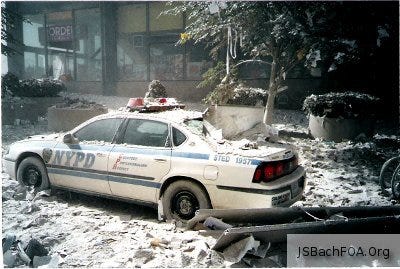
…As I started walking north, towards a barrier set up by the police a few blocks away from the trade center, I noticed that there weren't many people in the street ahead of me, although there were a few policemen and firemen at the barrier. Suddenly they started to wave and shout "hurry up, run". I thought they were just trying to keep the street clear, until they turned and ran themselves. I looked back and saw that the building was collapsing, and that there was a wall of dust and debris heading my way.


… Now here's a strange thing. I looked back over my left shoulder and I saw the building falling northwards, the way a tree would fall, tipping over, pivoting at its base. The picture in my mind is as clear as a bell. I saw the top half of the building falling to the north, but off to the side of me, above the surrounding buildings. This is not what actually happened, and I had to watch the re-runs on TV to convince myself that what I had "seen" was completely wrong, and that the building had actually come straight down.
Anyway, I ran as fast as my legs would take me, and managed to get into a cross street to the east. I saw a couple of cops dart inside a doorway ahead, and I made for that. The wall of dust and debris was right behind me when I reached the door. I managed to get into the vestibule and close the door just as it went by. The air outside was dark brown. We all went inside the main building, which was apparently abandoned, to get some good air. Even inside, the air was slightly dusty, probably from the first collapse. After about fifteen minutes, the air outside had cleared enough for me to be on my way. I went over to Broadway, and started hiking uptown, looking for a phone to call my wife. By now I was recalling my last words, that I was going to stay in the building, and I wanted to find a phone as quickly as possible. The few pay phones that were still working had long lines. I had a cell phone, but it didn't work until later in the day.
I found a phone after an hour or so, and when I called home my daughter answered. She was relieved to hear from me. She and her husband had left work to be with my wife, who, it turned out, didn't know that my building had fallen. My daughter had found this out herself, minutes earlier, and now she had to break the news to her mother. When they heard my voice, the three of them were so relieved, they wanted to jump in the car and come to Manhattan to rescue me. With great difficulty I persuaded them not to do so.
…I found that no busses or subways were running, and that all the bridges were closed. By early afternoon, my cell phone had come back on, and I was able to let my wife know how things were going. Around two thirty, I decided to walk over to Penn Station, which I could see a block away, to find out if any trains were running, and to see if it might be a good place to wait for the city to come back to life. As luck would have it, there was a train getting ready to leave for Washington, via Newark, and I managed to get on. When we arrived on the Jersey side, we had a clear view of Manhattan. It was awful. There was a huge column of smoke over the entire southern end of the island. I got off in Newark, and with a little shuttling, arrived back in Hoboken in time to catch my regular train home. There weren't many people on the train, which is normally filled. New Jersey Transit deliberately didn't collect any fares, which was a nice gesture. So ended my day.
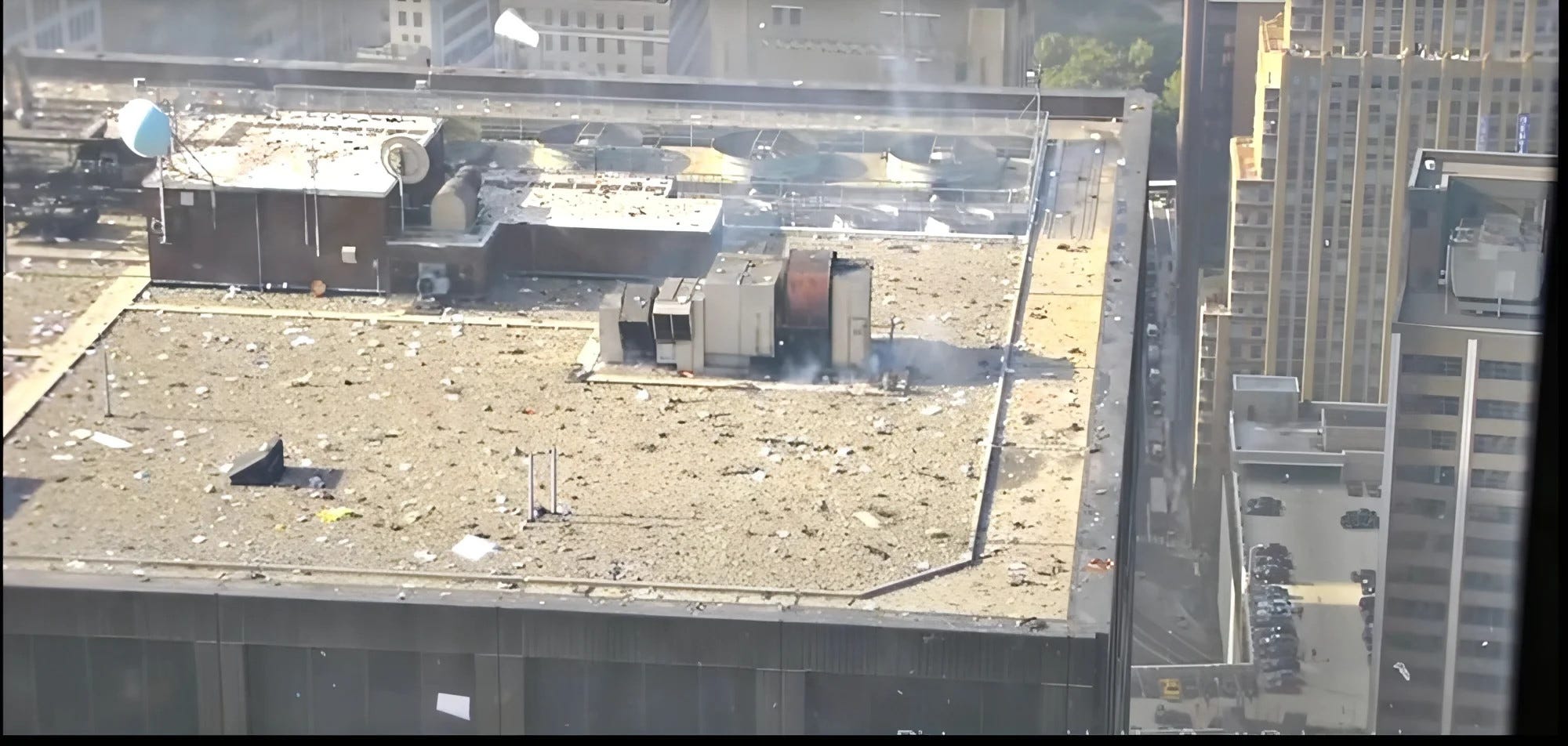
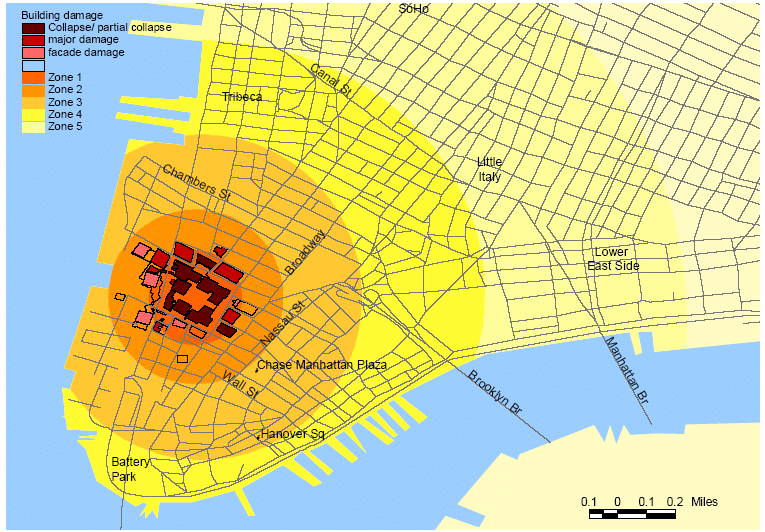
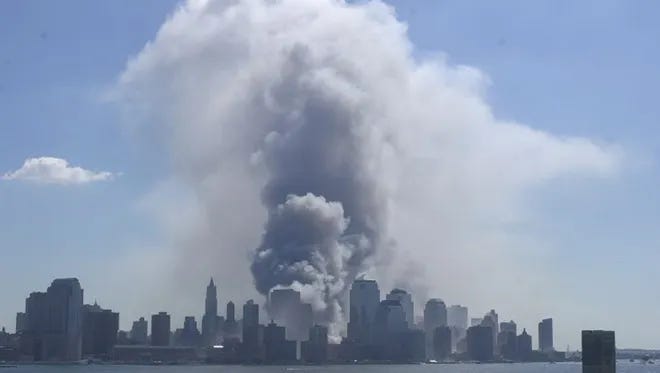
The waterfall of debris resulted in the severe damage (or total destruction) of dozens of other structures in and around Ground Zero, leading to the eventual collapse of 7 World Trade Center at 5:21 p.m. Researchers determined that the plume shot up nearly a mile into the sky, and spread out for 44 miles above all of Manhattan, drifting across the East River into Brooklyn
Several survivors spoke of people being burned by what they believed was burning jet fuel pouring down the face of the building as they made their way out of the lobby. Burning debris also lit adjacent buildings on fire.


One reporter who spent the day on foot trying to make it across the Hudson river described lower Manhattan and the World Trade Center site itself as “a huge, smoking, biblical pillar of cloud.”
This apartment on Liberty Street in lower Manhattan was directly across from the WTC complex, and is shown following the collapse of the Towers. The photograph was taken by Todd Maisel on Friday, September 14, 2001.
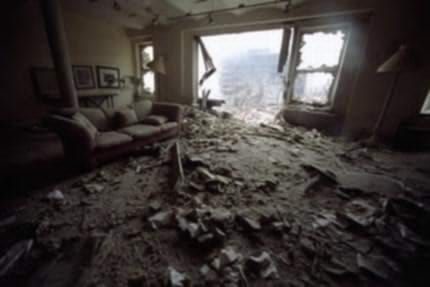
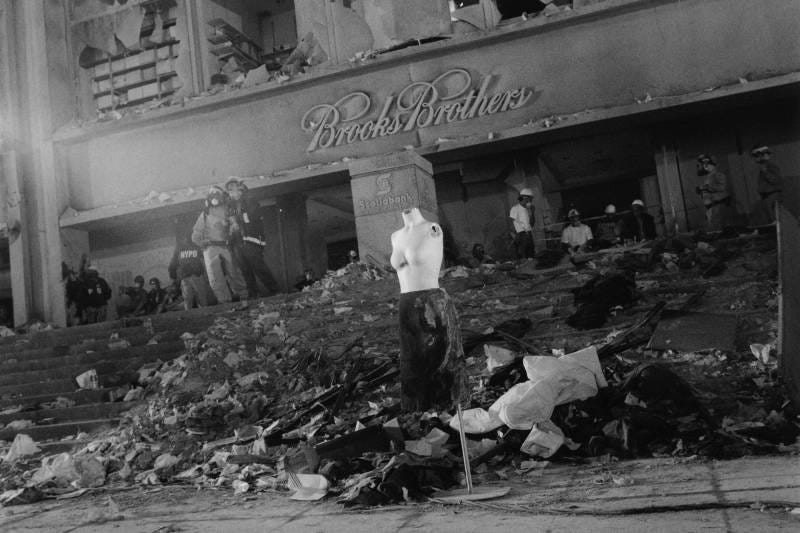
The images above of the Liberty Street apartment, and below showing before and after images of the Brooks Brothers storefront along with pictures of the interior showing the level of devastation that impacted the surroundings of the World Trade Center.


The Brooks Brothers store was in what was the Merrill Lynch building at 1 Liberty Plaza, formerly the U.S. Steel Building. The store, which closed in 2018, became a temporary morgue after 9/11, with bodies recovered from the Pile being temporarily stored in the men’s shirts department.


A third flight, American Airlines Flight 77, crashed into the Pentagon at 09:37 A.M., causing a partial collapse of the outer ring and killing 184 people, 59 people on the plane and 125 people in the Pentagon.
The plane hit the E Ring at the first deck level between Corridors 4 and 5 and penetrated to the alley between the C Ring and B Ring. There likely would have been more victims at the Pentagon, except that the section of the Pentagon which was hit was under renovations at the time of the attack.
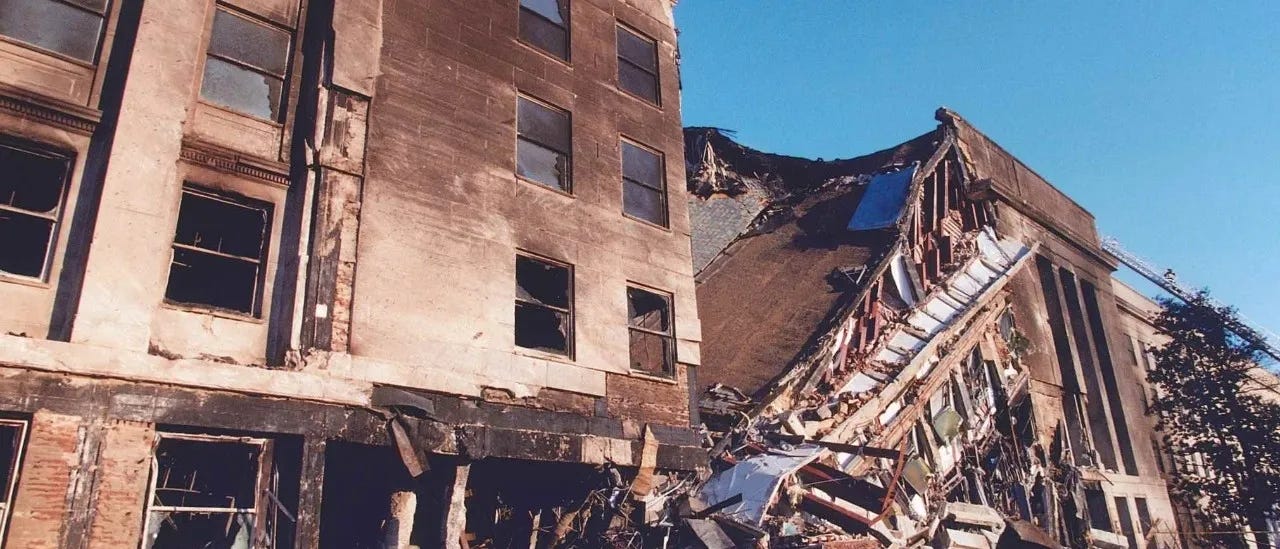
This renovation was part of the Pentagon Renovation Project, which was carried out from 1998 to 2011, partly due to security concerns that grew in the wake of the 1993 attack on the North Tower of the World Trade Center and the 1995 bombing of the Murrah Federal Building in Oklahoma City.


In 2021, PBS re-published a story originally from The War Horse titled, “An Untold Story of Escape from the Pentagon on 9/11,” detailing what it was like for those inside when Flight 77 tore through the building.
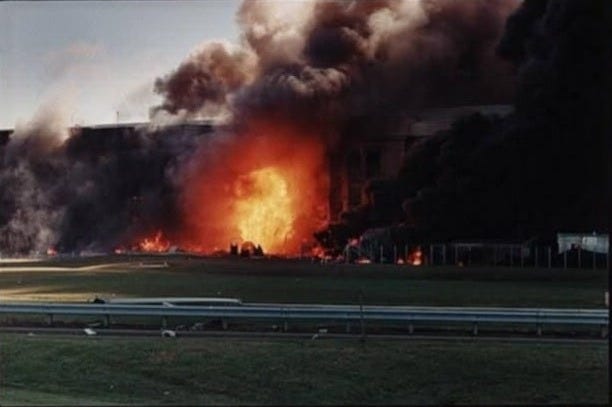
Bobby Hogue woke up on his office floor covered in jet fuel. Thick black smoke consumed the room, dancing in a searing amber glow. Hogue’s head and ears pounded. His body throbbed with pain. As he pulled himself to his feet, the reality unfolding around him began to sink in. Through a crack in the floor, he could see a raging inferno on the deck below. He yelled out to his three office mates. All of them were injured, one so concussed he could barely move. Hogue stumbled to the only door in the office and pulled the handle with all of his strength. The explosion had wedged the door shut. They were trapped.
For five minutes, one of the trapped men, Cpl. Tim Garofola, strained to pry open the door, creating a crevice. As fire began to melt objects to the floor, the damaged structure of the Pentagon ached and moaned around them. After the group squeezed through the doorway, they stepped into another apocalyptic scene. They had two options: Escape through the south corridor, which had collapsed during the blast; or use the north corridor, engulfed in flames and billowing smoke.
As they contemplated which direction to run, they heard a voice from behind the black veil.
“If you can hear my voice,” came a call, “come this way.”
A combination of heat, structural damage, and jet fuel made several office doors explode, driving wooden shards deep into the walls as Hogue and Garofola helped rescue their injured coworkers from the carnage threatening them all.
“Fire wasn’t the scariest part,” Hogue told The War Horse during months of interviews. “It was the threat of collapse.”
The group rushed down the halls and stairways as a growing trail of people followed. All searched for a path to safety. The security at the Pentagon, meant to keep enemies from breaching its perimeter, had trapped them within the fortified walls. They pushed past security guards, who tried to keep them inside as if it were a normal day. They made it to a restricted subway entrance and exited the Pentagon into a parking lot.
Hogue also spoke of not realizing the extent of injuries he sustained in the attack for days afterwards as he attempted to meet his obligations as military leadership following an attack on the United States.
One week after the attack, Hogue decided to get medical help for his injuries. “I just couldn’t deal with it,” he said. “I couldn’t stand, I couldn’t sit for long. I couldn’t hear. I couldn’t focus. My head was killing me.” Hogue was quickly escorted to the Pentagon emergency room.
“I thought I was making space for others to get to the head of the line,” Hogue said, but when he arrived, the clinic was empty. During his evaluation, Hogue’s hearing loss was described as “profound,” medical records show, and an otolaryngologist removed chunks of gypsum, cotton, and items Hogue said looked “like chopped up matchsticks with pieces of cement” attached to them from his ears.
“It was just a weird moment,” Hogue said. “The compression is so strong it’s ripping apart the walls and stuffing them into orifices in your body.”
The story about Pentagon survivor Robert Hogue includes a sobering story from the wars that followed:
Cpl. Jason Dunham was mortally wounded in Karabilah, Iraq, after he jumped on an enemy grenade to save the lives of his Marine squad. Dunham died days after receiving his Purple Heart, and was eventually awarded a medal of honor for his sacrifice.
Hogue told The War Horse that what Dunham’s mother told him following the death of her son still resonates with him twenty years later.
“The price of freedom is blood,” Deb Dunham told him.
Her words echo Thomas Jefferson, who said in 1787, “The tree of liberty must be refreshed from time to time with the blood of patriots and tyrants.”
Many Americans understand this instinctively. The terrible price of freedom is the legacy that our ancestors have left us, gift and burden in equal measure. The passengers of the last airplane to be hijacked on September 11th would become a symbolic embodiment of that legacy.
Their heroic sacrifice marked the end of the terror of the day, foreshadowing the bloody struggle to come in which thousands of Americans like Cpl. Jason Dunham would pay the ultimate price.
Their sacrifice sent a simple message to the world:
America will not cower under threat; America will fight back, whatever the cost.
United Airlines Flight 93 was flying out of New Jersey from Newark International Airport to San Francisco International Airport in California, making it the only plane hijacked that day not bound for Los Angeles.
About forty minutes into the flight, at 9:25 A.M. from high above eastern Ohio, the pilots radioed air traffic control in Cleveland about an alert that flashed across the cockpit computer screen:
beware of cockpit intrusion
Just minutes later, at about 9:28 A.M., air traffic controllers heard screaming as the hijackers stormed the cockpit, overpowering the pilots after murdering a passenger in the cabin.
The cockpit microphone was activated by the pilots as soon as the flight deck was breached, allowing air traffic control (and later investigators) to eavesdrop on the hijacking.
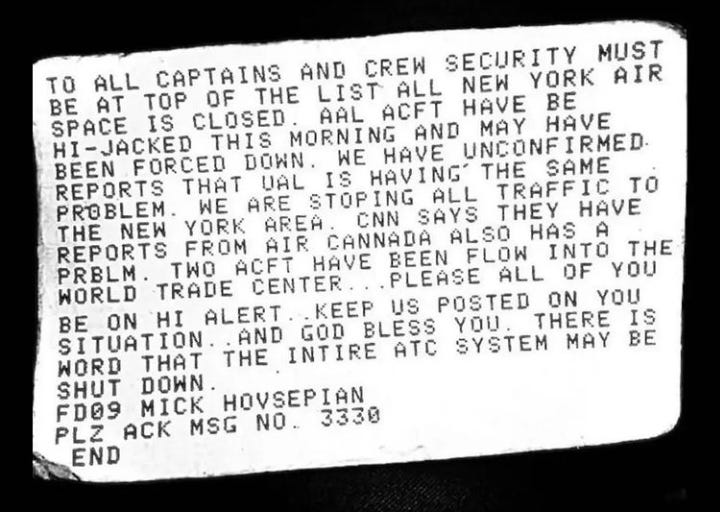
The hijackers disengaged the autopilot and told passengers, "Keep remaining sitting [sic]. We have a bomb on board."
Passengers were herded into the back of the plane, which changed course, heading for the District of Columbia. There was a hitch in the plan, though.
Flight 93 was 42 minutes behind schedule when it left the runway at 08:42, and the hijackers made a decision to wait an additional 46 minutes to launch the hijacking, which meant that the people being held hostage on the flight had already learned about the other hijackings.
Notified of the attacks on the Twin Towers and the Pentagon via cell phone by family on the ground, passengers staged a counter-hijacking in a valiant attempt to either re-take control of the flight or, failing that, to fly the plane into the ground so that it couldn’t be used to kill anyone else, according to victim Todd Beamer, a passenger who was on the phone with an airphone supervisor.
His last request was, "If I don't make it, please call my family and let them know how much I love them."
Beamer was only on the flight because he chose to spend time with his pregnant wife rather than take an earlier flight the day before. Todd Beamer's daughter, Morgan Kay, was born January 9, 2002, four months after Beamer's courageous sacrifice.
According to accounts of various cell phone conversations, Todd Beamer, Jeremy Glick, Mark Bingham and Tom Burnett came up with a plan to try and take the plane back from the hijackers, leading the other passengers in the effort.
The only child of Jeremy and Lyzbeth Glick, Emmy Glick wasn’t even 3 months old when her father died on United Flight 93. Glick's last words to his wife before hanging up his cell phone were:
"We're going to rush the hijackers."
They were all former athletes. Glick was a national collegiate Judo champion, and the former captain of his college rugby team. Mark Bingham was a former two-year captain of his high school rugby team, and a two time national rugby champion. Todd Beamer was the captain of his college team, and Tom Burnett was a quarterback in both high school and college.
Their counter offensive began at 09:57 A.M. after the passengers held a democratic vote on whether or not they should take action. Following the vote, Todd Beamer’s last words were heard by telephone, with GTE Airfone supervisor Lisa Jefferson and FBI agents listening on the ground.
"Are you ready? Okay. Let's roll."
Lisa Beamer, Todd Beamer’s widow, later published a book called about 9/11 called Let’s Roll, where she talks candidly about her life with Todd and the devastating day her children learned their father had died. She also talks about the peculiar mix of grief and joy she felt giving birth to the daughter she was pregnant with when Todd died.
CeeCee Lyles called her husband one last time from a cell phone and told him the passengers had voted to force their way into the cockpit. The mother-of-four called twice, but could not reach her husband, a police officer who was sleeping after a night shift.
"Hi baby, I'm — baby, you have to listen to me carefully. I'm on a plane that's been hijacked. I'm on the plane, I'm calling from the plane. I want to tell you that I love you. Please tell my children that I love them very much. And I'm so sorry baby. I don't know what to say. There's three guys, they've hijacked the plane … we're turned around and I heard that there's planes that have been flown into the World Trade Center. I hope to see your face again, baby. I love you. Bye." — CeeCee Lyles
The hijackers became aware of the passenger revolt at 09:57:55, when one of the terrorists is heard on the flight recorder:
"Is there something? A fight?"
They rolled the wings left and right and pitched the nose up and down to throw the passengers around. The cockpit voice recorder captured sounds of crashing and screaming, followed quickly by shouts of pain and distress in the silence that followed, coming not from a passenger, but from a hijacker stationed outside the cockpit door who was being attacked by passengers as their assault continued, undeterred.
The voice recorder also picked up the sound of passengers using a food cart as an improvised battering ram against the cockpit door, until around 10:02:33, when a hijacker is heard repeatedly screaming "Give it to me!"
Other hijackers inside the cockpit are heard yelling "No!" over the sound of breaking glass.
The final words on the recorder are a calm, American voice in English:
"Pull it up."
Flight 93 crashed in an empty Pennsylvania field, near Shanksville, about 20 minutes outside of Washington, D.C. The Boeing 757-222 had 44 passengers and crew, and their revolt is credited with foiling the terrorists, preventing them from reaching their intended target. Khalid Sheikh Mohammed and Ramzi bin al-Shibh told interrogators was the United States Capitol Building, although investigators believe that the White House may also have been a target.
National Security Advisor Condoleezza Rice told CBS that, “…[the passengers] saved us not only physically but psychologically and symbolically in a very important way, too.”
One person saw the impact; several saw it as it descended, and an oral history has been created to memorialize what they saw.
"When the plane came through here, I could see the wingtips were vertical," Eric Peterson said in 2002. "I could see the roof of the plane and the tops of the wings.”
To this day, conspiracy theories remain about Flight 93, the most common being that the military forced it down. Peterson says that's not true.
"The conspiracy people can say what they want to say – there are always going to be that kind of people in the world [who] are not going to believe," he said, "but I know what I saw that day and that's enough for me."
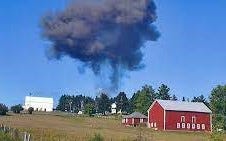
The lone witness to the crash, Nevin Lambert, described in 2002, “It was going upside down and all at once it made the 45 degree angle and it went right down…"
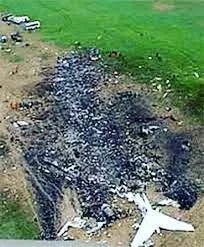
There is disagreement between family members of the victims and investigators as to whether passengers succeeded in their mutiny against the hijackers. Many family members, having personally heard the audio recordings, believe the passengers killed the hijackers outside the cockpit, successfully breached the cabin, and had re-taken control of the plane in the moments before the crash.
Sandy Dahl, widow of pilot Captain Jason Dahl, said Captain Dahl’s voice was the final voice she heard on the cockpit recording, saying “Pull it up.”
According to experts, although it is possible for a Boeing 767 to fly upside down, the plane does not have the wing design or enough engine power to recover from such a position and will enter into a terminal descent.
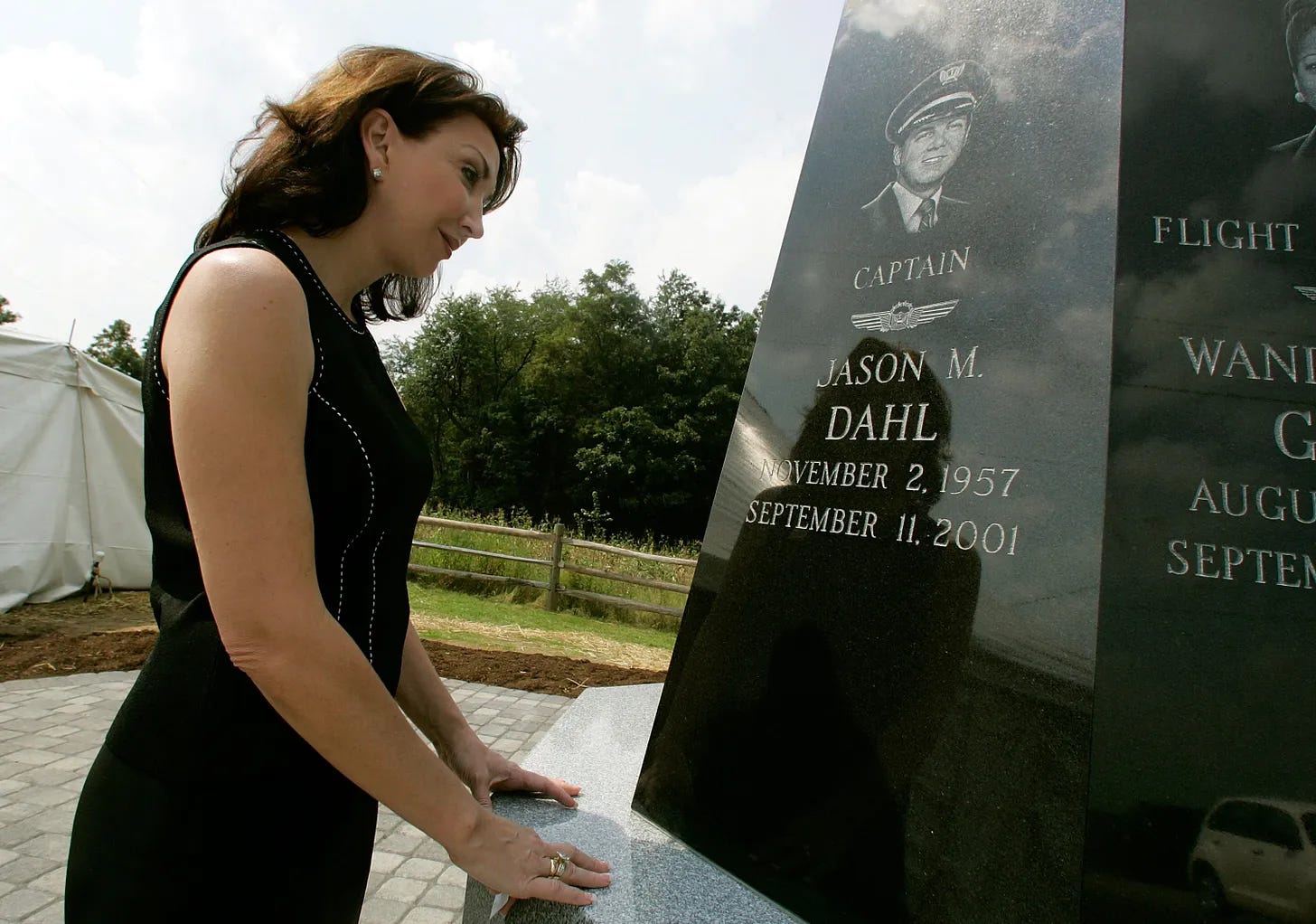
In 2012, Dahl, age 52, was found dead in her home in Colorado. There was no indication of foul play; she reportedly died of an accidental drug and alcohol overdose. It is impossible to say how many other spouses, brothers, sisters, fathers, mothers, sons, and daughters have died as an indirect result of the attacks.
Tom Burnett had a daughter when he still a teenager who had been adopted by a local family; she gave her perspective on the impact that 9/11 had on families in a Marie Claire article:
In 2001, during my junior year of high school, the principal announced over the loudspeaker that two planes had crashed into the World Trade Center. Everyone was upset, but I felt a strange, overwhelming sadness deep in my gut that I couldn't explain.
When I got home, I blurted out to my mom that I thought one of my birth parents had died. I'd never had such a strong intuition before. My mom reassured me that the odds of this being true were tiny. But that scary intuition still haunted me.
In the weeks that followed, I was too spooked by my hunch to watch any coverage of 9/11, but it was impossible to escape. Tom Burnett, one of the men who helped thwart the hijackers' plans to crash United Flight 93 into the White House or Capitol, grew up nearby, so his photo and story were everywhere. I tried to tune it all out. I just went on with my life, hanging out with friends and writing for the school newspaper.
When I turned 19 in January 2004, I requested a copy of my birth certificate. Six weeks later, my mom called to tell me it had arrived and confessed that she'd opened it. When I asked the names of my parents, she insisted we would discuss it when I came home that night for spring break. Her curt tone surprised me; she'd always been very supportive of my search
…
I also asked if one of my birth parents was dead, but she repeated that we would talk when I got home. I hung up and started sobbing. I suddenly knew that my dad was the Flight 93 hero from the news. I just kept thinking That Tom guy is my father. My gut feeling on 9/11 had been right all along.
When my parents showed me my birth certificate, they were shocked that I'd already figured it out. They tried to comfort me, but I was too upset. I'd waited so long to meet my birth dad, and now it was too late.
Tom’s widow later gave Burnett’s daughter an unfinished letter he had written her, apologizing for putting her up for adoption as he struggled through the end of his teens.
A temporary memorial for Tom Burnett, Todd Beamer, Jeremy Glick, Mark Bingham, Captain Dahl, CeeCee Lyles, Edward Felt, and the other victims was built near the crash site following the attacks. The National Park Service acquired the land, and construction of the permanent Flight 93 Memorial was dedicated on September 10, 2011, and the Visitor Center opened to the public on September 10, 2015.
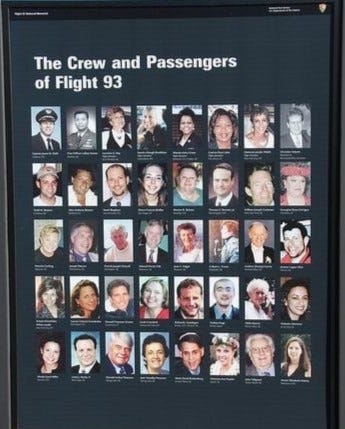
Scott Matthew Davidson, father of SNL alum Pete Davidson, was a New York City firefighter with Ladder 118 who died along with the rest of his entire unit, firefighters Vernon Cherry, Leon Smith, Joey Agnello, Robert Regan, and Pete Vega.
Davidson, then aged seven, was deeply wounded by the loss of his father, later being diagnosed with Borderline Personality Disorder seemingly as a result. He told The New York Times the experience was "overwhelming" and that he had problems acting out as a result of his trauma.
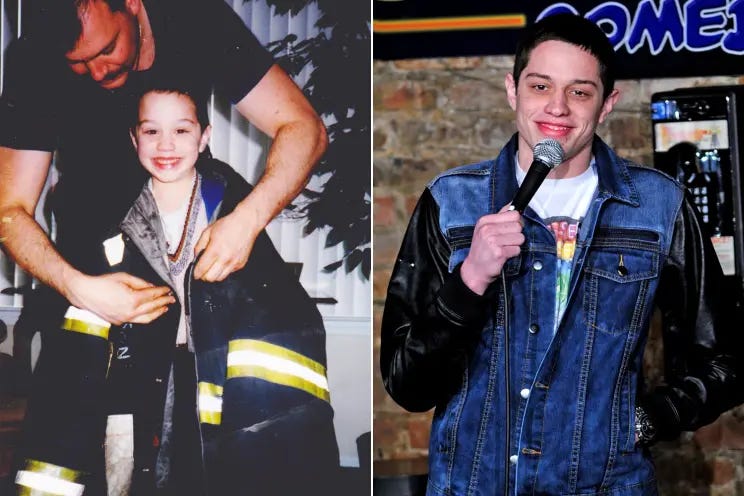
Scott Davidson was last seen running up the stairs of 3 World Trade Center just before the building was completely destroyed in the collapse of Towers. 3 World Trade Center originally opened in April 1981 as the Vista International Hotel.
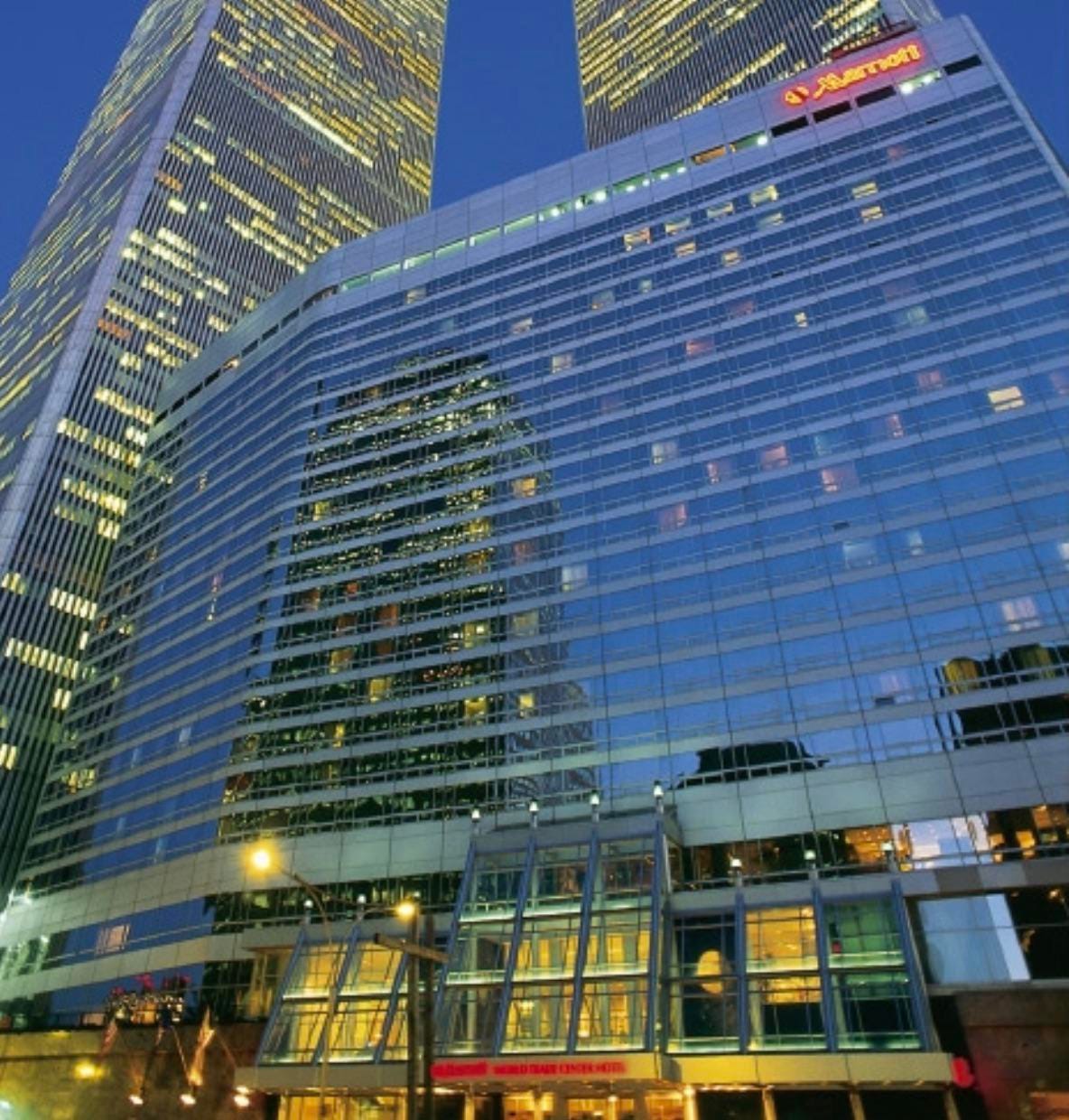
It was also known as World Trade Center 3, WTC 3 or 3 WTC, the World Trade Center Hotel, the Vista Hotel, and the Marriott Hotel.

Police and firefighters responded to the World Trade Center in just minutes. By 9:00 A.M., less than fifteen minutes after the first impact and before the second, firefighters had established a command post in the lobby of the North Tower and the FDNY chief had taken personal command of the rescue operation.
Firefighters were required to ensure all floors were completely evacuated, and problems with radio communication caused the firefighters who went into the buildings to lose contact with their command. Many off-duty firefighters had also arrived at the scene to help and didn’t even have radios. As a result, many firefighters were unable to hear evacuation orders, and 342 firefighters died in the collapse of the towers, as did 23 NYPD officers and 37 Port Authority Police Department officers.


One such firefighter was David J. Fontana of FDNY, who died along with 11 other members of Squad 1. It was his 8 year wedding anniversary; he married his high school sweetheart, Marian Fontana, on September 11, 1993. David and Marian had a son, Aidan, who was 5 years old at the time.
Another was Michael T. Weinberg, a native of Queens and a firefighter with FDNY Engine Company 1. Only 34 years old, Michael was a lifeguard‚ a licensed physical trainer‚ a former minor league baseball player, a 1988 MVP of the Big East Conference, and a professional model.
On September 11th‚ he was off duty and on vacation, waiting his turn to play at the Forest Park Golf Course in Queens when he saw the first plane crash into the North Tower. He immediately raced to his firehouse‚ and from there, drove the chaplain, Father Mychal Judge, and Captain Dan Brethel to Ground Zero. All three were killed in the collapse of the South Tower.
A book about Father Judge said that many considered Judge to be a living saint; he was well known in the city for ministering to the homeless and the sick; he started what was likely NYC’s first active AIDS ministry in the city's first AIDS ward. His friends revealed after his death that he had been gay.
One man who was dying of AIDS asked him, "Do you think God hates me?"
Judge reportedly took the man into his arms, kissed him on the head, and silently rocked him back and forth to comfort him.
Another story about Judge tells of him literally giving the coat off of his back to a homeless woman on the street in winter, later recalling that, "She needed it more than me."
Judge was the first body recovered from Ground Zero; he was praying in the North Tower lobby when the South Tower collapsed, sending debris flying through the North Tower lobby, killing many inside including Judge.
Judge was in one of the most famous photographs from the attacks, taken by Reuters photographer Shannon Stapleton, in an event also filmed by Jules and Gedeon Naudet: Judge's body being carried out of the North Tower just before it collapsed by Firefighters Christian Waugh and Zachary Vause, NYPD Lt. William Cosgrove, civilian John Maguire and FDNY EMT Kevin Allen) shortly before it collapsed.
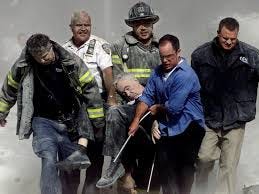
Captain Dan Brethel died trying to save Michael Weinberg’s life; as the tower began to collapse on top of them, Brethel grabbed Weinberg and pulled him beneath a firetruck for shelter. The falling building crushed them both. Brethel had also been off duty when the attacks occured.
Judge's fire helmet and coat are on display at the New York City Fire Museum. Weinberg’s fire helmet was recovered from Ground Zero and donated to the 9/11 Memorial Museum by his family to share his story.
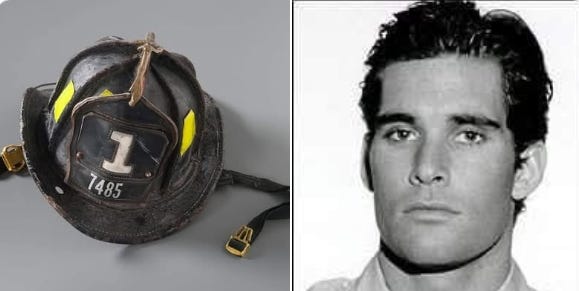
Jessica McBride, a journalist who was present when Brethel’s body was recovered, recalled breathing in “the dust of the dead” in a 2021 retrospective. She also said that:
It’s incumbent on those of us who were there and who lived it, even if from afar, to be the curators of that history and the voices of it.
In the photograph below, taken by survivor John Labriola, firefighter Mike Kehoe can be seen headed up the stairs of the North Tower just after 9 A.M. on September 11th, 2001.
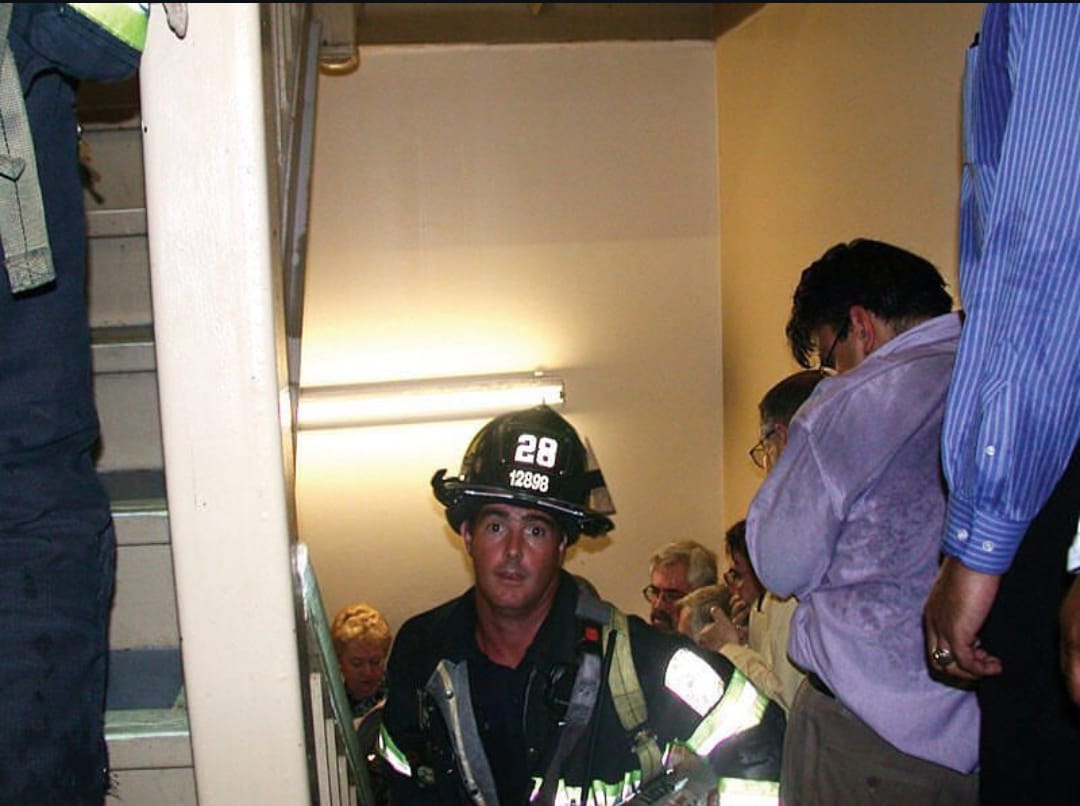
Amazingly, Mike Kehoe - husband of Edra, son of Robert, brother of Jimmy, and everyone at Engine 28, Ladder 11 on East 2nd Street in the East Village - survived. He doesn't know what floor he was on when John Labriola took his photo that day, but he knows he had reached the 28th floor when he heard an enormous rumble. That rumble was the South Tower collapsing.
Unlike so many of his colleagues, his radio was working, and he heard his lieutenant order him to return to the lobby immediately. As he got to the lobby, he felt the building begin to tremble, shudder, and shake. He fled the lobby seeking shelter from the debris that the tower rained down on the streets below. Less than a minute later, the tower was gone.
"I survived. I don't know how, I don't know why, but I survived," Mike said in an interview.
Manhattan Island witnessed the largest maritime evacuation in history as an estimated 500,000 to 1,000,000 people were evacuated by water in the eight-hours following the attacks, with several capturing surreal images of the collapse.
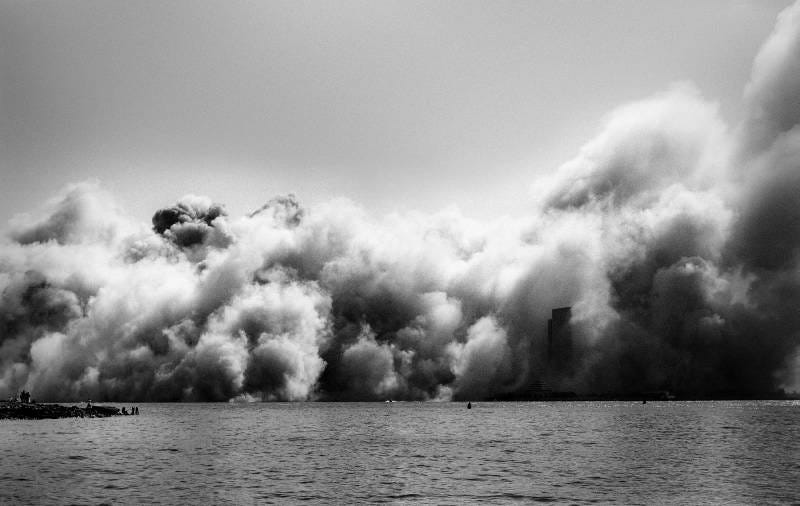
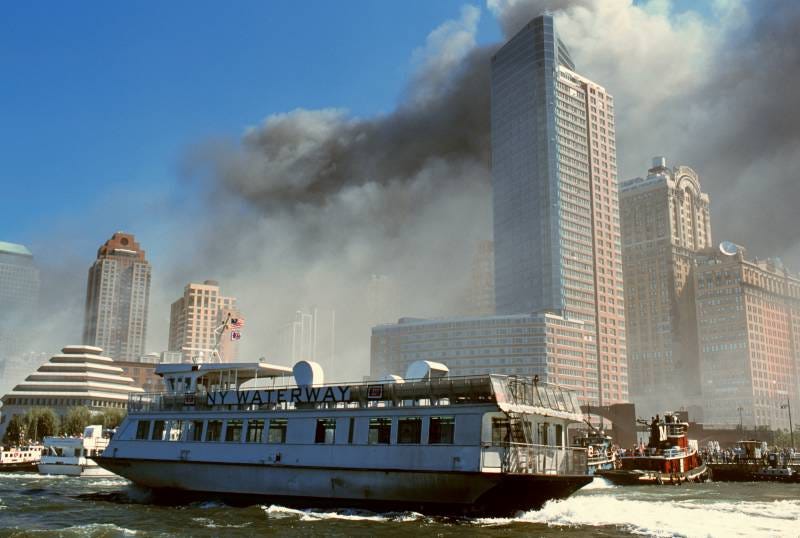
More than 30,000 people and hundreds of dogs participated in search and rescue missions after the collapse of the Towers at great personal risk. On the day following the attacks, eleven people were rescued, pulled alive from the rubble, including six firefighters and three police officers. One woman was rescued from near where a West Side Highway pedestrian bridge had been. Two Port Authority police officers were also rescued, pulled out alive after spending nearly 24 hours beneath 30 feet of rubble. Their rescue was later portrayed in the 2006 film World Trade Center.
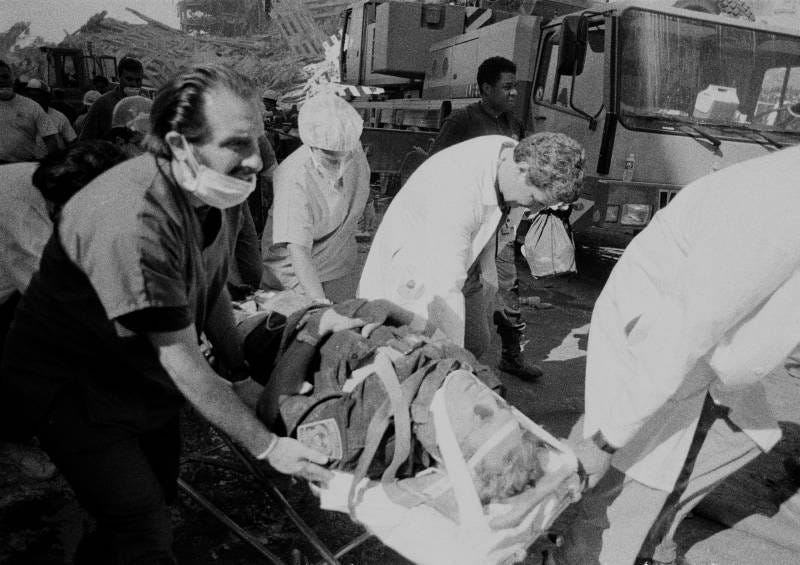
Rescue efforts were paused numerous times because nearby buildings were in danger of collapsing. In total, twenty survivors were pulled out of the rubble. The final survivor was rescued 27 hours after the collapse of the North Tower, and the last fires at the World Trade Center site were extinguished on December 20, exactly 100 days after the attacks.
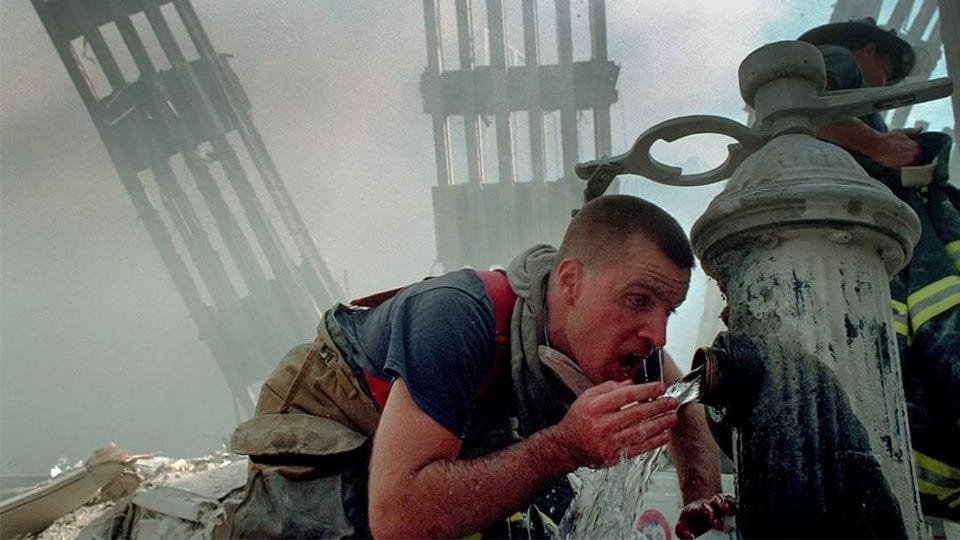
When the North Tower collapsed, smoldering debris hit several of the surrounding structures, including 7 and 5 World Trade Center, damaging the external fascia of the buildings and starting fires that no one could do anything about as a result of a lack of water pressure.
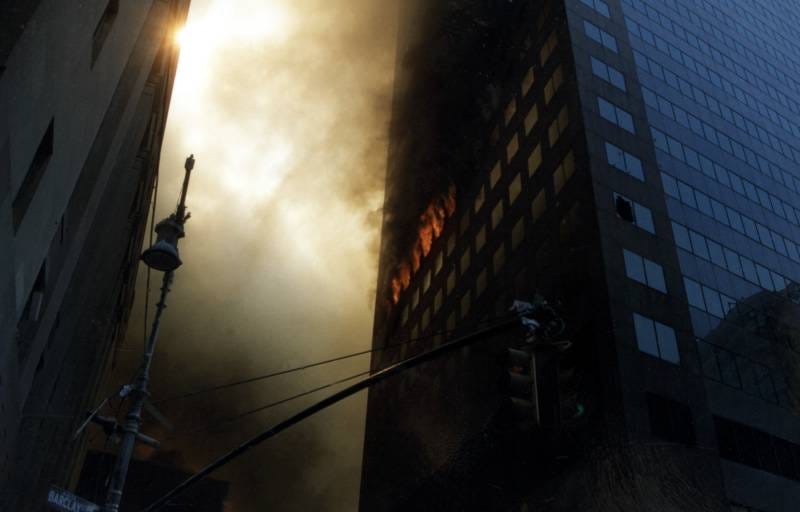
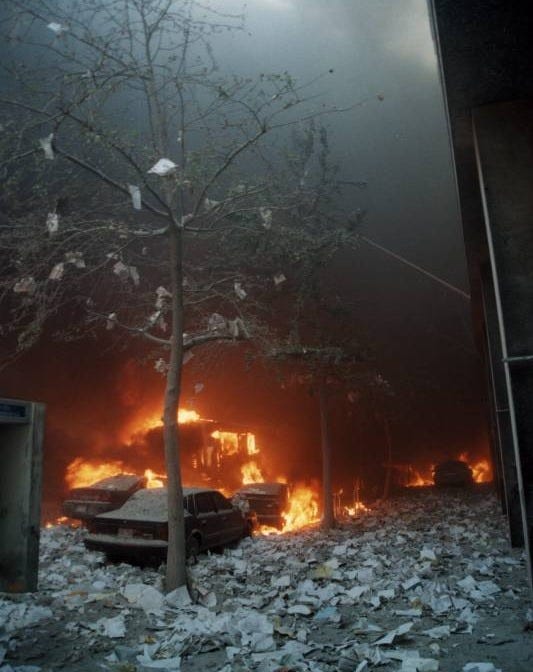
The massive fires in the Towers overwhelmed the fire sprinkler systems and caused such a high demand for water that it exceeded the capacity of the city's water supply network in the immediate area around the towers, causing a lack of water pressure that hindered the effort to suppress fires.
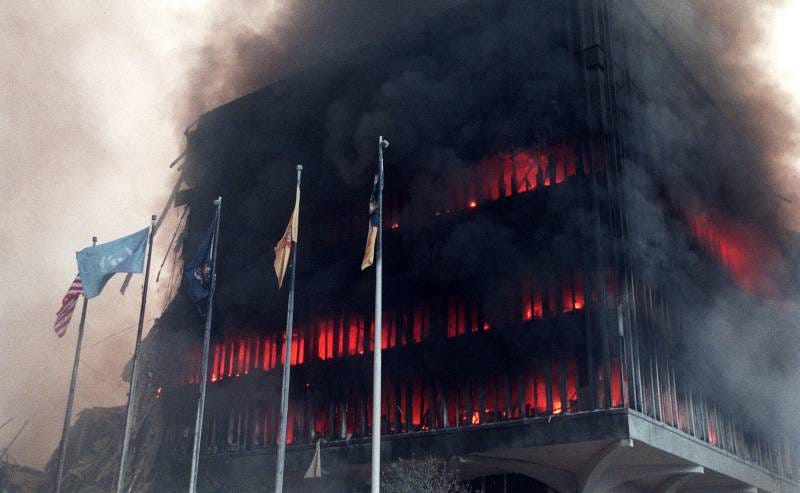
Fire was observed on at least ten different floors of building 7 between floors 6 and 30. At about 2:00 P.M., firefighters noticed a bulge in the southwest corner between the 10th and 13th floors, suggesting that the building was unstable and might collapse, and firefighters also heard strange creaking sounds coming from the building. It collapsed at about 5:21 P.M.
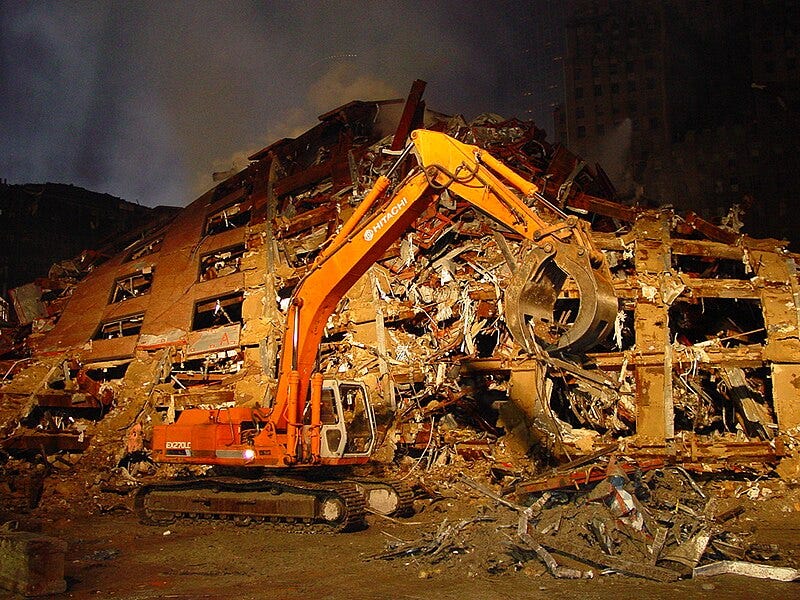
The same thing happened to WTC 5. Below, you can see what WTC 5 looked like following the collapse of the South Tower, WTC 2 in the leftmost photo, as well as what it looked like after the fire in the middle photo, and the debris field of the North Tower, WTC 6, and WTC 7, in the rightmost photo.


These photos help us understand the forces that the surrounding buildings were subject to in the collapse of the skyscrapers. Below are some that were released by NIST following their investigation of the collapse and rescue effort.


Another image that illustrates the forces involved in the collapse are before and after photos of The Sphere, an art piece that was at the center of the World Trade Center complex. In the original site plan design by Japanese-American architect Minoru Yamasaki and Yamasaki Associates, along with associate architect Emery Roth & Sons, you can see the Sphere outlined to the right of the North Tower.
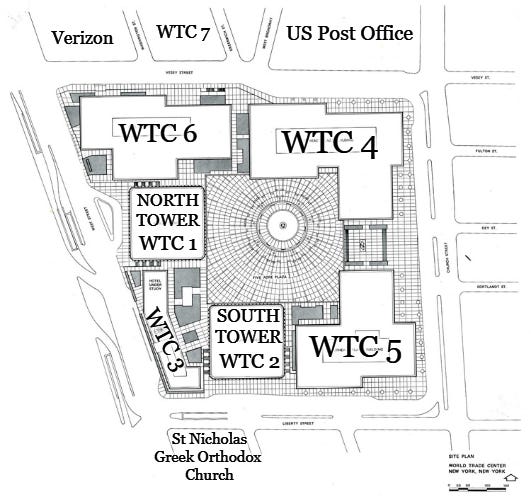
The Sphere, originally called "Große Kugelkaryatide N.Y.", was the world's largest bronze sculpture, standing in the Austin J. Tobin Plaza, a 5 acre public square that was the largest plaza in New York City by acreage.


It was dedicated to world peace through trade. It was nicknamed "Koenig Sphere," and then simply, The Sphere," by New Yorkers. It stood 25 feet high, 17 feet wide, and weighed 45,000 pounds, rotating once every 15 minutes. It was the only mostly intact work of art recovered from the Pile.
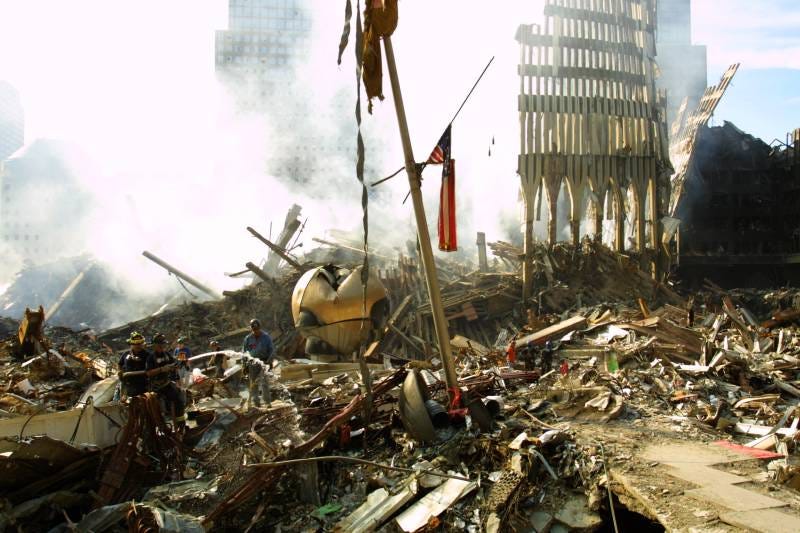
It was dismantled and stored in a hangar at John F. Kennedy International Airport, installed as a memorial in Battery Park from 2002 and 2017, then moved to Liberty Park, where it overlooks the September 11 Memorial and its original location.


The sculpture was the subject of the 2001 documentary Koenig's Sphere. A plaque that now accompanies The Sphere reads:
For three decades, this sculpture stood in the plaza of the World Trade Center. Entitled The Sphere, it was conceived by artist Fritz Koenig as a symbol of world peace. It was damaged during the tragic events of September 11, 2001, but endures as an icon of hope and the indestructible spirit of this country. The Sphere was placed here on March 11, 2002 as a temporary memorial to all who lost their lives in the terrorist attacks at the World Trade Center.
This eternal flame was ignited on September 11, 2002, in honor of all those who were lost. Their spirit and sacrifice will never be forgotten.
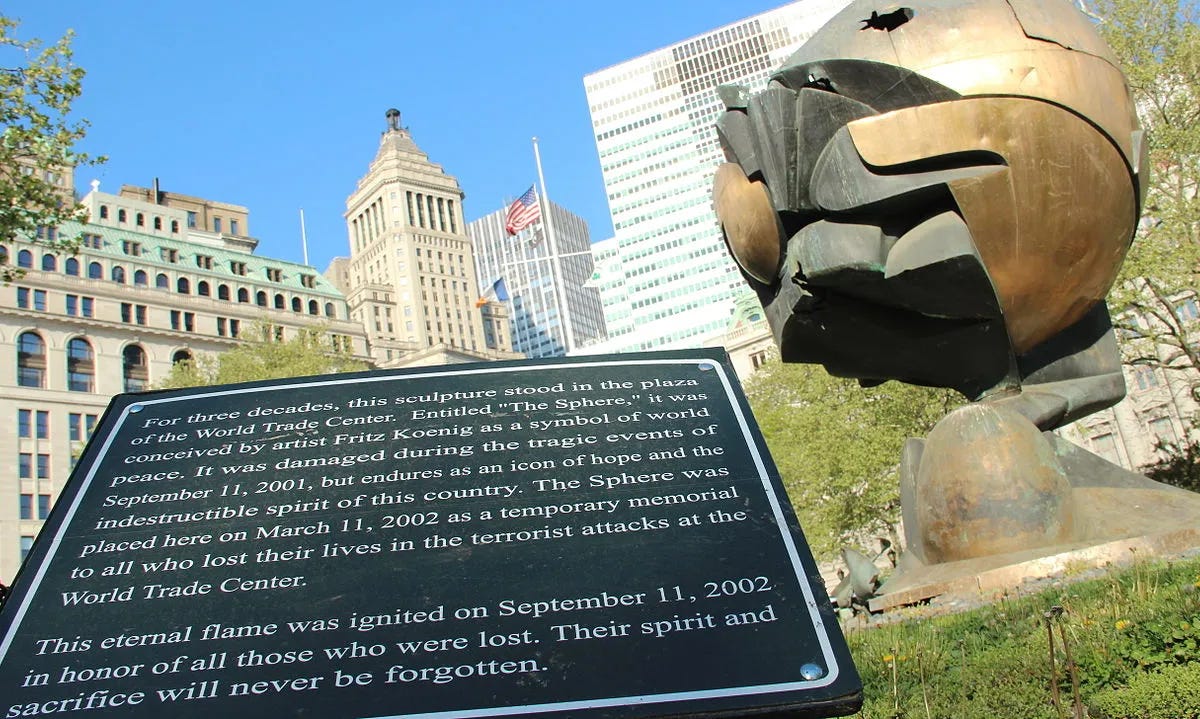
The destruction visited upon the vehicles surrounding the World Trade Center site illustrate the destructive forces of the collapse all too well.


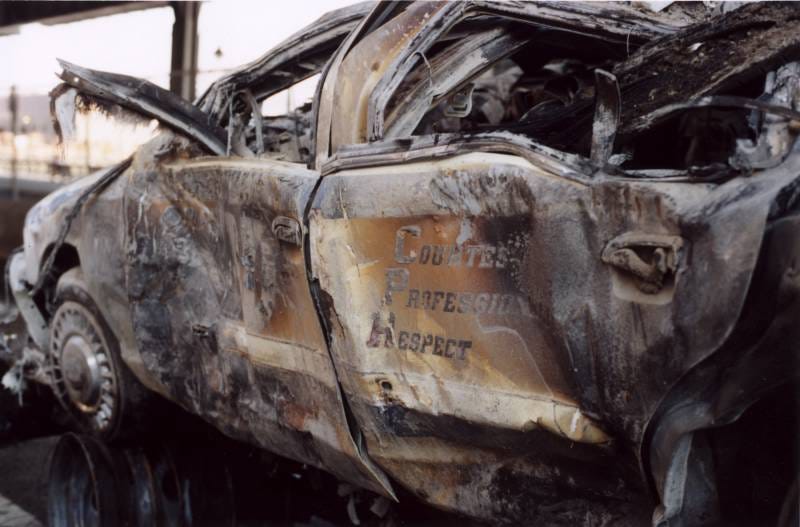
The devastation was such that it could be seen from space, as in these photos below released by NASA the International Space Station which orbits the earth at about 17,000 mph 250 miles in altitude.
Former NASA astronaut Frank Culbertson was the only American not on the planet. He was with two Russian cosmonauts — in the International Space Station, which was still being built. Culbertson captured Manhattan on September 11, filming from space for NASA while satellites also tracked the site from orbit.


Immediately following the attacks, missing persons flyers began to sprout up around the city, as people desperate for news about their loved ones began the frantic search for answers.


Impromptu memorials joined the endless flyers as America began to mourn its dead and accept that missing were gone forever.


The 110-story World Trade Center Twin Towers are the tallest freestanding structures ever to collapse. Estimates suggest that after accounting for property damage, cleanup, the long term health impact of the particulate debris, the investigation and the subsequent Global War on Terror, the total economic impact of the September 11 attacks was between $5 and $10 trillion USD.
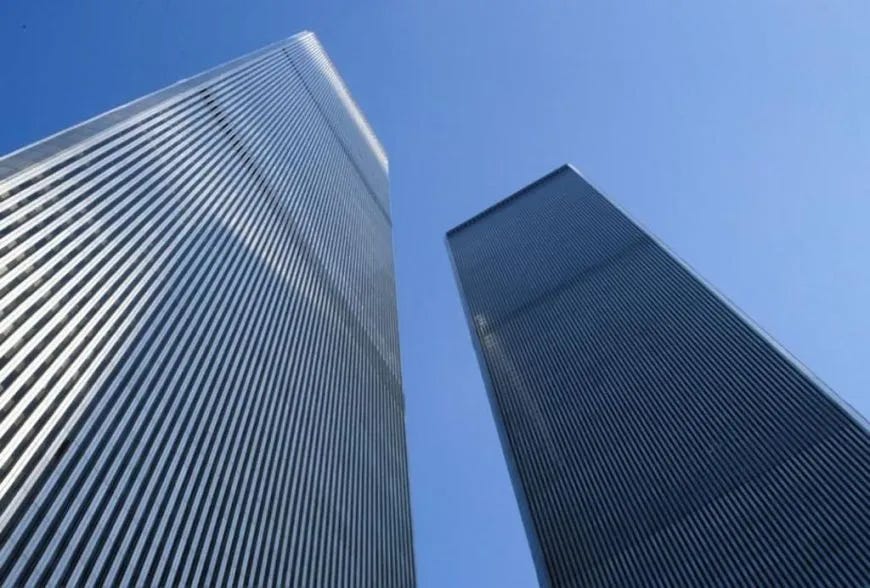
The hijackings, crashes, fires and subsequent collapses killed 2,977 victims and injured over 6,000. To date, nearly 3,000 World Trade Center Health Program members have also died from 9/11-related respiratory or digestive disorders, or 9/11-related cancers. This suggests health issues resulting from the attacks have killed more Americans than the attacks themselves, as this only includes members of the WTC Health Program.


Pictured below is 28-year-old Marcy Borders seeking refuge from the collapse of the South Tower in a nearby office building after escaping from the 81st floor of the North Tower. She told news reporters afterward that as the north tower crumbled before her eyes, a stranger had pulled her to safety, into the building lobby.
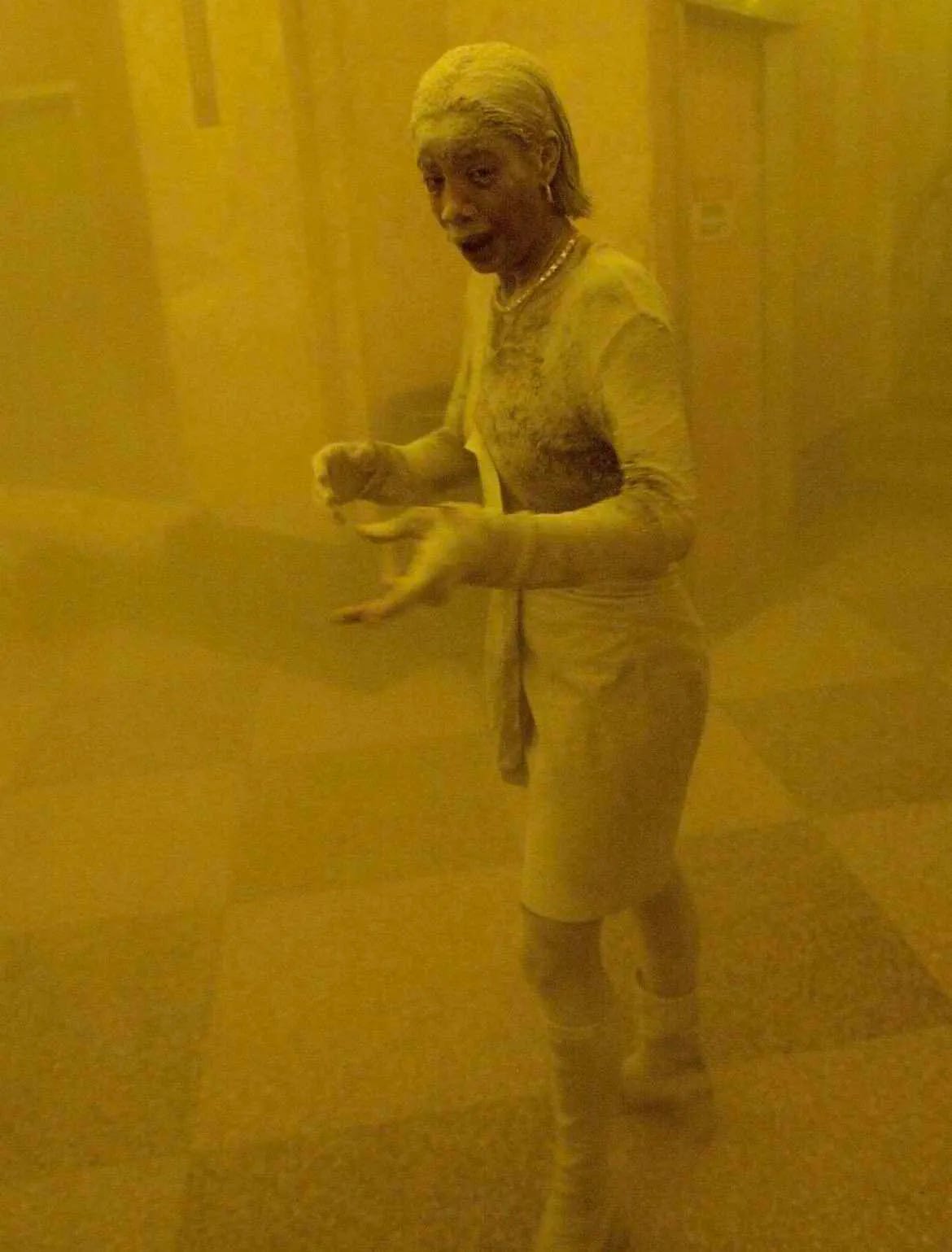
Nicknamed “The Dust Lady” in media coverage, Borders worked as a legal assistant for Bank of America at the time of the attack. She never recovered from the trauma of her experiences. Frightened of tall buildings and airplanes, her post traumatic stress disorder led to a break-up with her partner, an addiction to alcohol and drugs, caused her to lose of custody of her children.
In late April of 2011 she checked herself into a rehab center. About a week later, on May 2, 2011, at 11:35 p.m., President Obama appeared on major television networks to announce:
Tonight, I can report to the American people and to the world that the United States has conducted an operation that killed Osama bin Laden, the leader of al-Qaeda, and a terrorist who was responsible for the murder of thousands of innocent men, women, and children
Borders said that Bin Laden’s death at the hands of the United States Navy Seals helped her return to sobriety as she was finally able to move on from the events she witnessed. The mission, Operation Neptune Spear, was part of an effort led by the Central Intelligence Agency (CIA), with the Joint Special Operations Command (JSOC) coordinating the Special Mission Units involved in the raid. In addition to SEAL Team Six, the 160th Airborne Special Operations Aviation Regiment and the CIA's Special Activities Division also participated in the raid.
Borders was diagnosed with stomach cancer in August 2014 which killed her in August 2015. She believed that her cancer was caused by the toxic dust exposure; the cancer rate among survivors is 31.4% higher than average.
"I definitely believe it because I haven't had any illnesses. I don't have high blood pressure, high cholesterol, diabetes," she said.
The cancer left her in $190,000 of debt, despite that she did not undergo surgery, and still needed additional chemotherapy. A fund had been created to pay for the medical care of first responders and other survivors, but Borders said she could not even afford to get her prescriptions filled.
Over 200 people packed into Angelic Baptist Church, where Borders wake and funeral were, and hundreds more stood on the street outside, lining the staircase leading up to the church's entrance and the sidewalk.


First responders exposed to Ground Zero were also subject to illnesses: the cancer rate among those heroic workers is 18.5% higher than average. Actor Steve Buscemi, who worked as a firefighter for FDNY in the 1980s, visited Ground Zero and volunteered in the days following the attack. He says that he’s suffered no health issues so far.
Although he avoided interviews or photographs, he can be seen in the far left of the image below, in full firefighter regalia, aiding in the rescue efforts. He spent a total of five days volunteering for grueling 12 hour shifts, which he said left him with post traumatic stress that will never leave him.
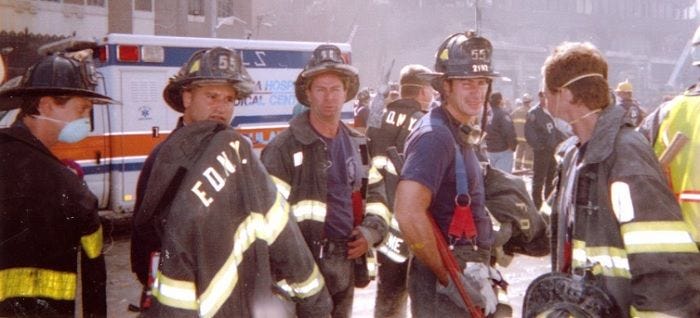
Buscemi also produced and narrated the documentary Dust to Dust: The Health Effects of 9/11, which was released on September 11, 2006. Directed by Brooklyn native Heidi Dehncke-Fisher, Dust to Dust is about the health effects of being in the vicinity of Ground Zero, and questions whether politics influenced federal Environmental Protection Agency claims about air safety following the collapse of the Twin Towers.
During the decades following the attacks, first responders and their supporters had to fight to prove those health effects were even real.
“We said we were sick from 9/11,” survivor John Feal said. “They [members of Congress] said we were making it up, it was in our heads, we were crazy. But we’re a finite number, and with these life-altering illnesses, we were dying off quicker than we were supposed to.”
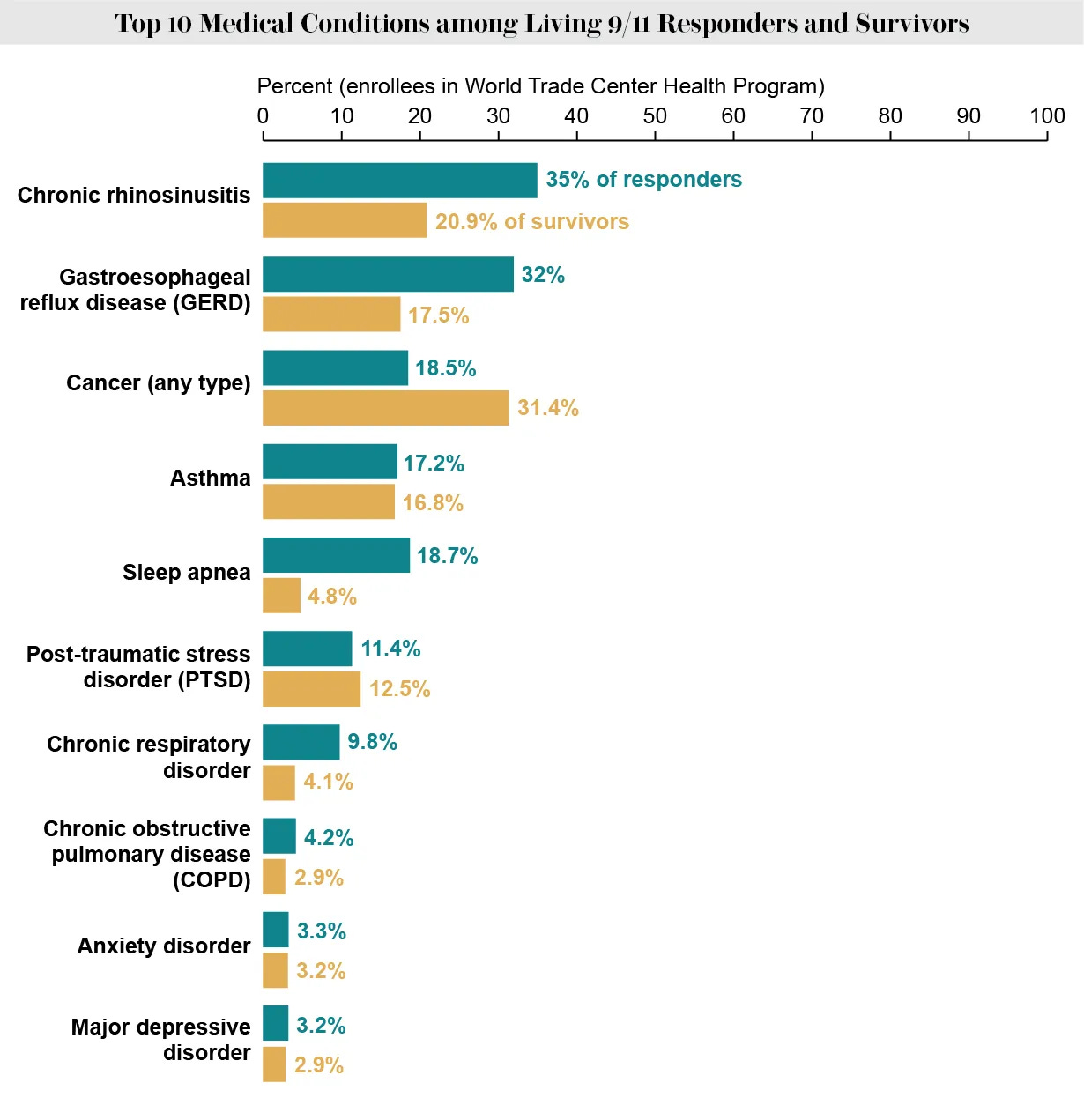
Feal's September 11th related injury occurred just outside of a 96-hour window, as he cleared debris to search for survivors, and he was denied compensation as a result. The denial led to him becoming an advocate for 9/11 first responders like Luis Alvarez, an NYPD bomb squad detective who responded to the attacks.
At a Congressional hearing in 2019 urging lawmakers to extend the fund that many police officers, firefighters and other emergency workers who responded that day depend on to pay their medical bills, Alvarez told members of Congress (and also empty chairs that should have held Congress members), “Less than 24 hours from now, I will be starting my 69th round of chemotherapy.”
“Yeah, you heard that correct. I should not be here with you, but you made me come. You made me come because I will not stand by and watch as my friends with cancer from 9/11, like me, are valued less than anyone else because of when they get sick, they die,” Alvarez said.
Alvarez received a standing ovation. Weeks after his testimony, Luis G. Alvarez died in hospice in Rockville Centre, N.Y. He was 53. His colorectal cancer was linked to the three months he spent at the site of the World Trade Center towers in Lower Manhattan, searching for survivors and remains of his fellow officers in the toxic rubble at ground zero.
Comedian John Stewart gave a speech immediately following Alvarez where, for 9 minutes and while choking back tears, he berated Congress for their inaction ensuring medical compensation for first responders.
Sen. Mike Lee, R-UT, joined Sen. Rand Paul, R-KY, as the only two votes against ensuring that emergency workers received health care for injuries sustained in their efforts to dig through the Pile of rubble. The Senate approved the bill, funding the program through 2090, by a 97-2 vote.
New York City firefighters donated a cross made of steel from the World Trade Center to the Shanksville Volunteer Fire Company in Shanksville, Pennsylvania. The beam, mounted atop a platform shaped like the Pentagon, was erected outside the Shanksville firehouse near the crash site of United Airlines Flight 93.
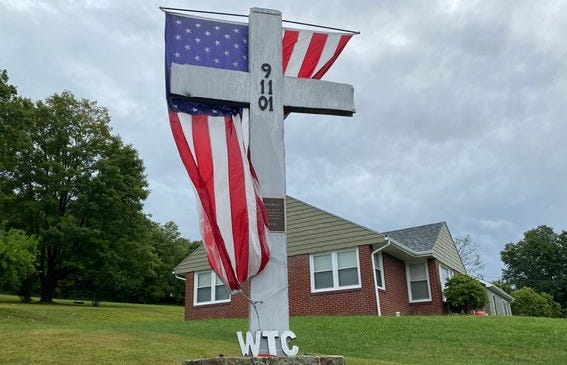
Other notable items found during the clearing of Ground Zero include objects called The Composites, which include the 6-ton chunk of melted steel, pulverized concrete and office furniture known as the Meteorite. These were created by the intense heat of the fires. The National Institute of Standards and Technology estimates that the temperature in the North Tower reached as high as 1,800° F.


On September 10, 2002, the Viewing Wall, a temporary display containing information about the attacks and listing the names of the dead, opened to the public. In the year following the attacks, Ground Zero became the most visited place in the United States.
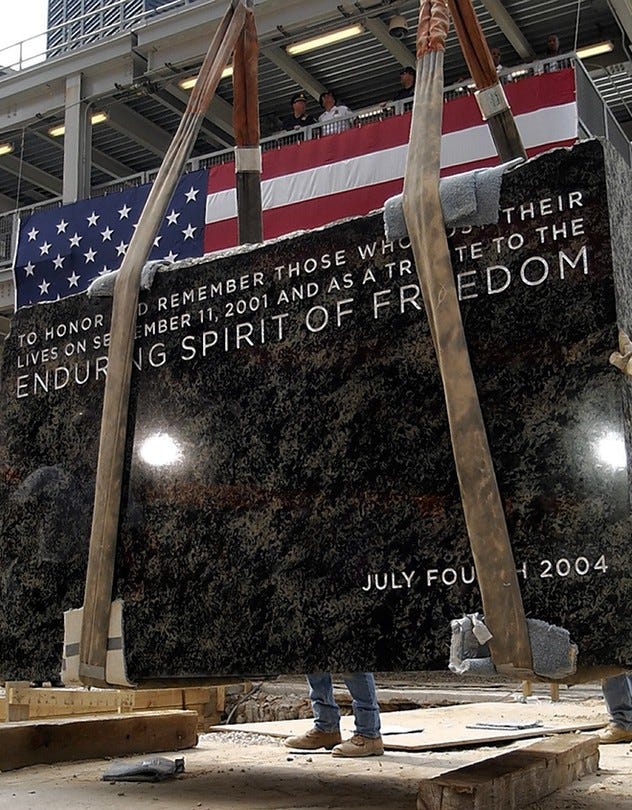
The Lower Manhattan Development Corporation organized a public competition to determine how to re-develop the WTC site in 2002. The public rejected the first round of designs, and a design by Daniel Libeskind won the second round in February 2003. A symbolic cornerstone was laid down in a ceremony on July 4, 2004 with a planned completion date in 2012.
The damage at the Pentagon was repaired much more quickly; The Phoenix Project was the name given to the project to repair the damage, and the project's goal was to reoccupy the outermost ring of the rebuilt section by September 11, 2002. Work was complete nearly a month early, with occupants moving back in on August 15, 2002.
The National 9/11 Pentagon Memorial honoring those who were lost was dedicated on September 11, 2008, and "Reflecting Absence" was selected as the WTC 9/11 Memorial in January 2004.
Designed by Peter Walker and Michael Arad, it opened in NYC on September 11, 2011, ten years to the day after the attacks, and less than six months after the killing of Osama Bin Laden.
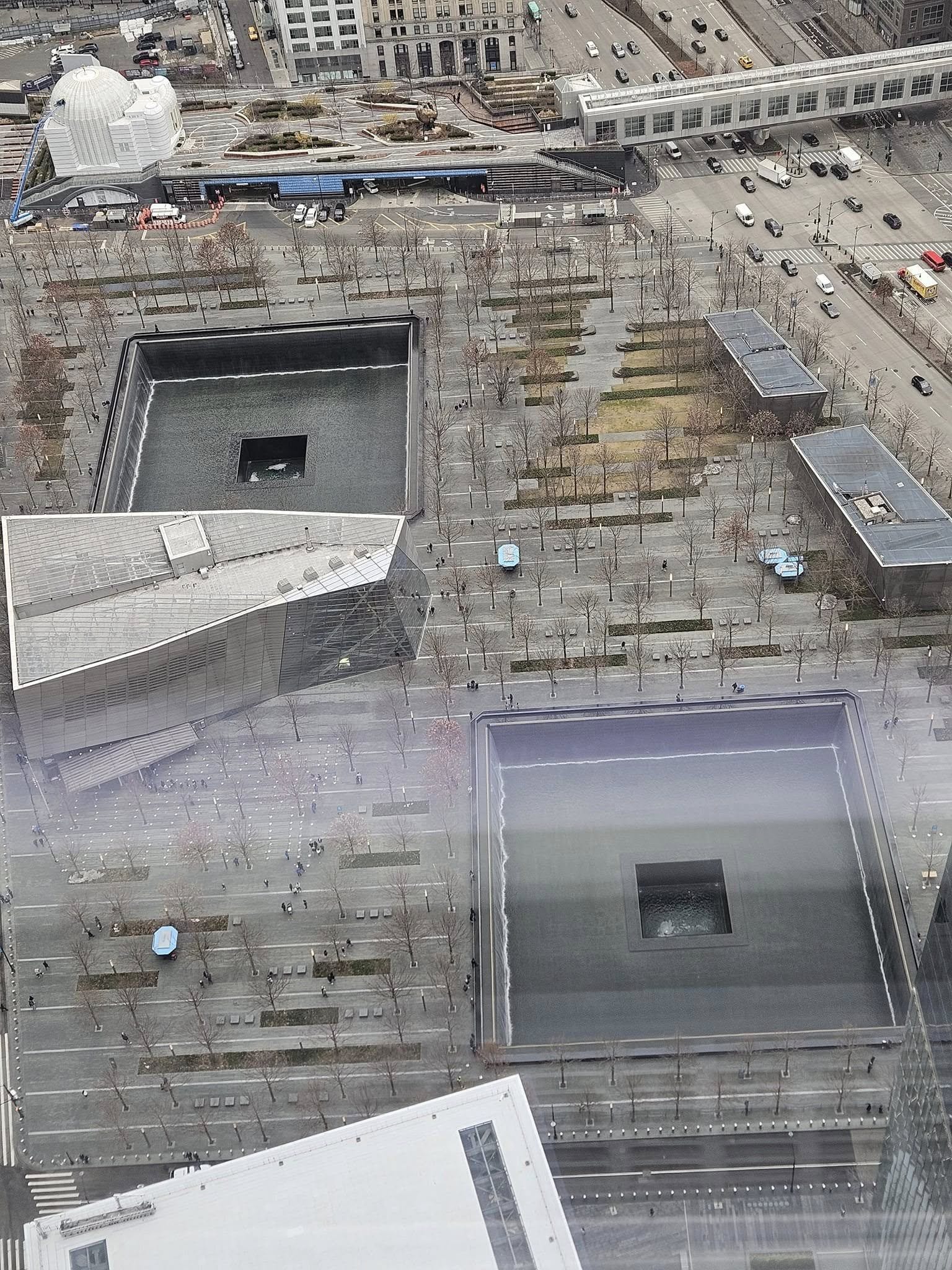
The design for the World Trade Center site went through many revisions before a final design for what was called "Freedom Tower" was formally unveiled on June 28, 2005, and construction didn’t begin until May of 2006. On March 27, 2009, Port Authority of NY & NJ announced that the Freedom Tower would be re-named One World Trade Center.


July 13, 2010, excavators discovered the remains of a 45-foot wooden sloop dating to 1773 22 feet below street level at the southern edge of the site in a pit that is now an underground security and parking complex. The vessel has since been installed at the New York State Museum in Albany.
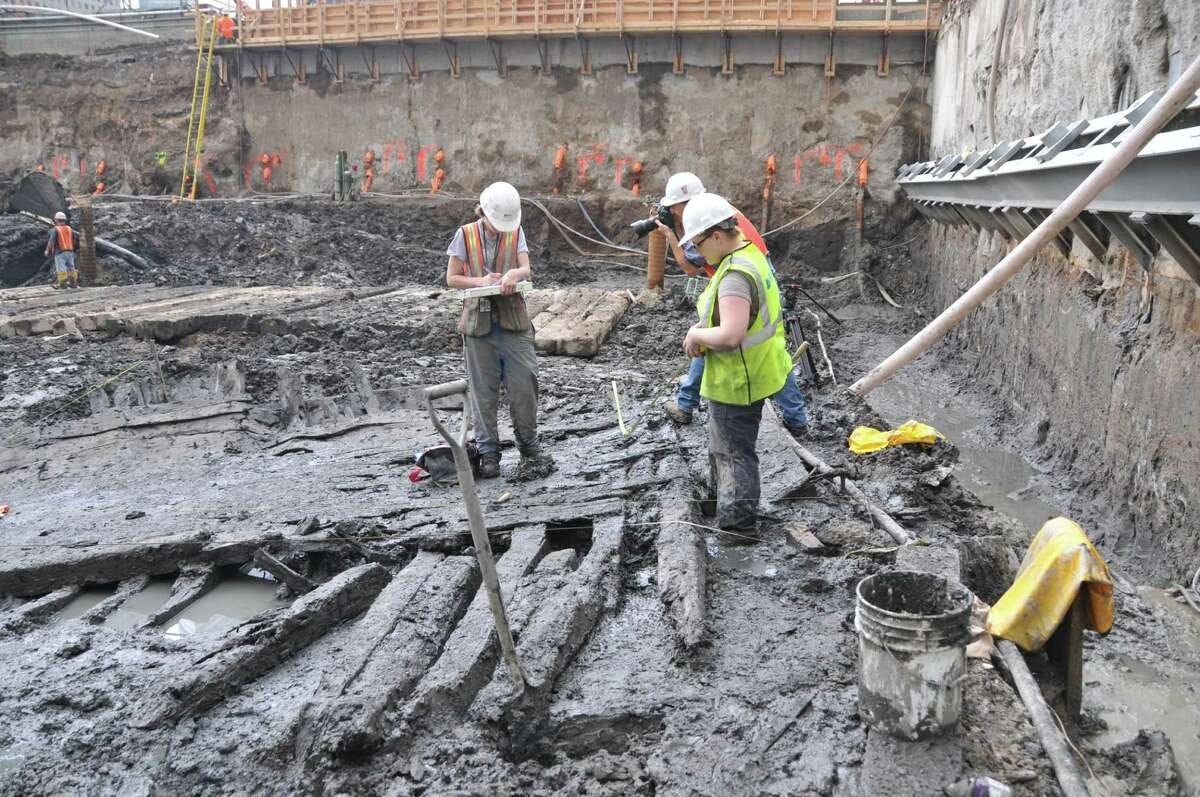
A study published in the journal Tree Ring Research said the analysis suggested that an old growth forest in the Philadelphia area of Pennsylvania supplied the white oak that was used to construct the boat, and that the trees were probably cut in 1773 or so, just a few years before the Revolutionary War.
The building formerly known as Freedom Tower first opened in November 3, 2014, to 175 employees of publisher Condé Nast. On May 29, 2015, One World Observatory at the tower's peak was opened to the public.
The final building has 94 stories, with the top floor numbered 104. The Twin Towers of the World Trade Center in New York City each had 110 floors, but One World Trade Center remains the tallest building in the United States.
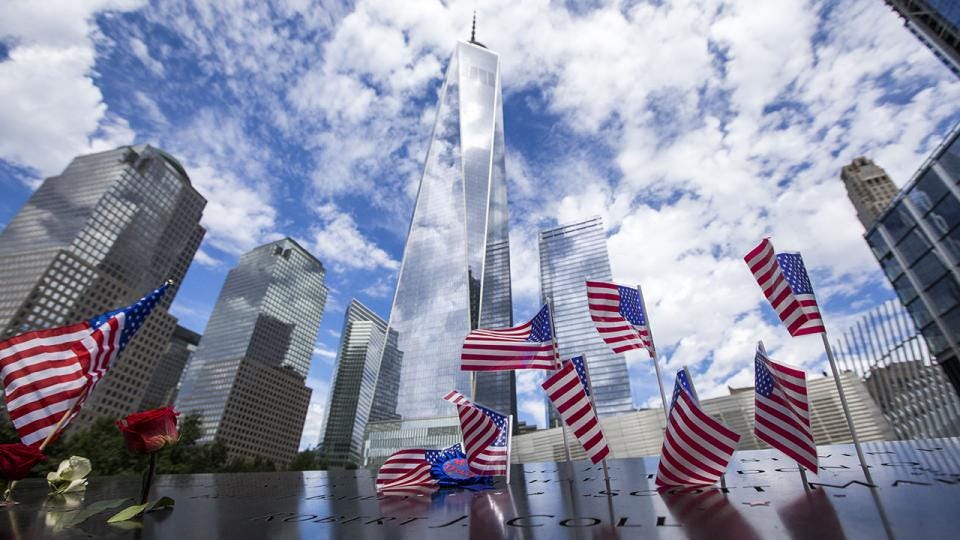
Saint Nicholas Greek Orthodox Church, which was the only house of worship destroyed in the attacks when it was buried in debris following the collapse of WTC 2, re-opened 19 years and 364 days later with a ceremonial lighting and memorial held on September 10, 2021.
The church was designed by Spanish architect Santiago Calatrava, with its dome, windows and iconography inspired by historic Byzantine churches like the Hagia Sophia in Istanbul, a domed temple built in 537 AD.
The Hagia Sophia served as the religious and spiritual mecca of the Orthodox Church for nearly a thousand years until the fall of Constantinople to the caliphate of the Ottoman Empire in 1453, after which it served as a mosque until 1935, when it became an interfaith museum.
The Hagia Sophia was reclassified from an interfaith museum back to a mosque in 2020 by the highest administrative court in Turkey, the Council of State, which ruled that its status as an interfaith museum was unlawful under Ottoman, Turkish, and Islamic law, and that it must remain a mosque.
Turkish historian Halil Inalcik, who died in Turkey at the age of 99 in 2016, emphasized the importance of religious zeal expressed as jihad as a primary motivation for the conquests of the Ottomans:
“The ideal of gaza, holy war, was an important factor in the foundation and development of the Ottoman state. Society in the frontier principalities conformed to a particular cultural pattern imbued with the ideal of continuous Holy War and continuous expansion of the Dar ul Islam — the realms of Islam — until they covered the whole world.”
This historical narrative - called the Gaza or Ghaza thesis - became subject to criticism in the later half of the 20th century, from western scholars who believe they know better. The argument goes that this is a narrative that serves current political objectives.
Saint Nicholas Greek Orthodox Church reopened just over a year after Turkey’s Council of State ruled that the Hagia Sophia must legally remain a mosque.


“One of the worst days in America’s history saw some of the bravest acts in Americans’ history. We’ll always honor the heroes of 9/11. And here at this hallowed place, we pledge that we will never forget their sacrifice.”
— President George W. Bush, excerpted from remarks made while speaking at the dedication of the 9/11 Pentagon Memorial
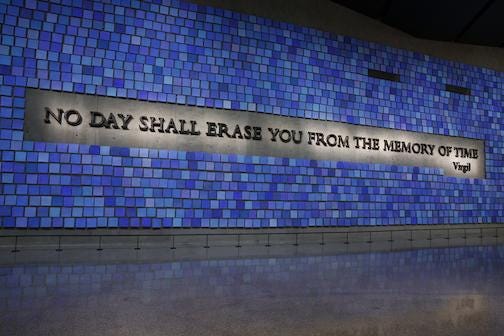
In addition to all those who died at the Towers, 40 souls perished aboard Flight 93; their bravery will outlive all of us. 184 lives were lost at the Pentagon on 9/11, including 59 souls aboard American Airlines flight 77 and 125 workers inside of the Pentagon, some of whom were civilians.
In total, 2,983 American names were inscribed in bronze on the Reflecting Absence Memorial in New York City, including 6 who died in the 1993 attack.
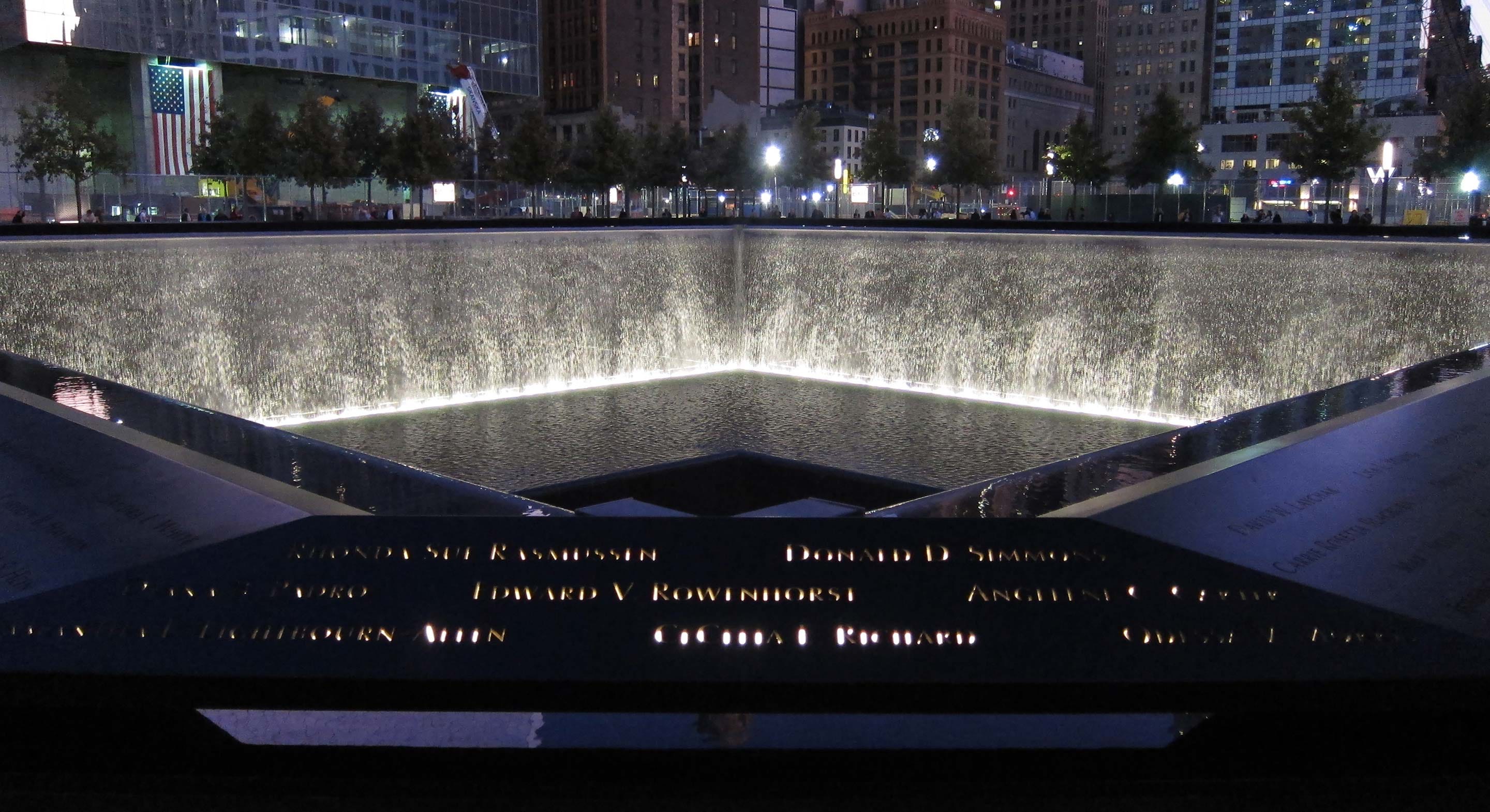
Thanks for this, it's so insightful. How do we ensure warnigs like those are heard?